
MechScript | updated 18 October 2026 | example amounts are fictional unless stated otherwise
The guide in one minute
Net metering is ending. Your solar panels are not.
From 1 January 2027, electricity you take from the grid and electricity you feed back into it will no longer be offset against each other. You will still receive compensation for exported electricity, but using your own solar power directly will become more financially important. [1, 2]
Remember: you do not pay your energy supplier energy tax or VAT on solar electricity you use directly in your home. From 2027, you will pay these on electricity imported from the grid. [1, 2]
Throughout this guide, we use one checkable example, show the complete energy bill and explain what fixed-price, variable-rate and dynamic energy contracts mean for you.
The photography is illustrative. Amounts in calculations are fictional unless an official tax amount and year are explicitly stated.
Reading guide
What you will find in this article
Who is it for? Households with solar panels, people considering them and anyone who wants to understand why the energy bill is changing. No technical background is needed.
Why this article?
Many people think solar panels will no longer make sense from 2027. Others think they will have to pay tax on all the electricity their panels generate. Both statements are incorrect. The situation becomes less favourable if you export a lot, but some of the financial benefit remains.
The confusion arises because solar panels involve four different quantities: production, direct self-consumption, grid import and export. You do not see all of them on the same meter. Your bill also contains several amounts that mean different things. So we start with the basics.
Four terms you need to know
- Production: all electricity generated by your solar panels.
- Direct self-consumption: solar electricity immediately used by appliances in your home.
- Grid import: electricity bought from your supplier when your own production is insufficient.
- Export: solar electricity you do not use and therefore feed into the public grid.
Your smart meter measures grid import and export. Total production is normally shown in your inverter app or by a separate PV meter.

How electricity flows through your home
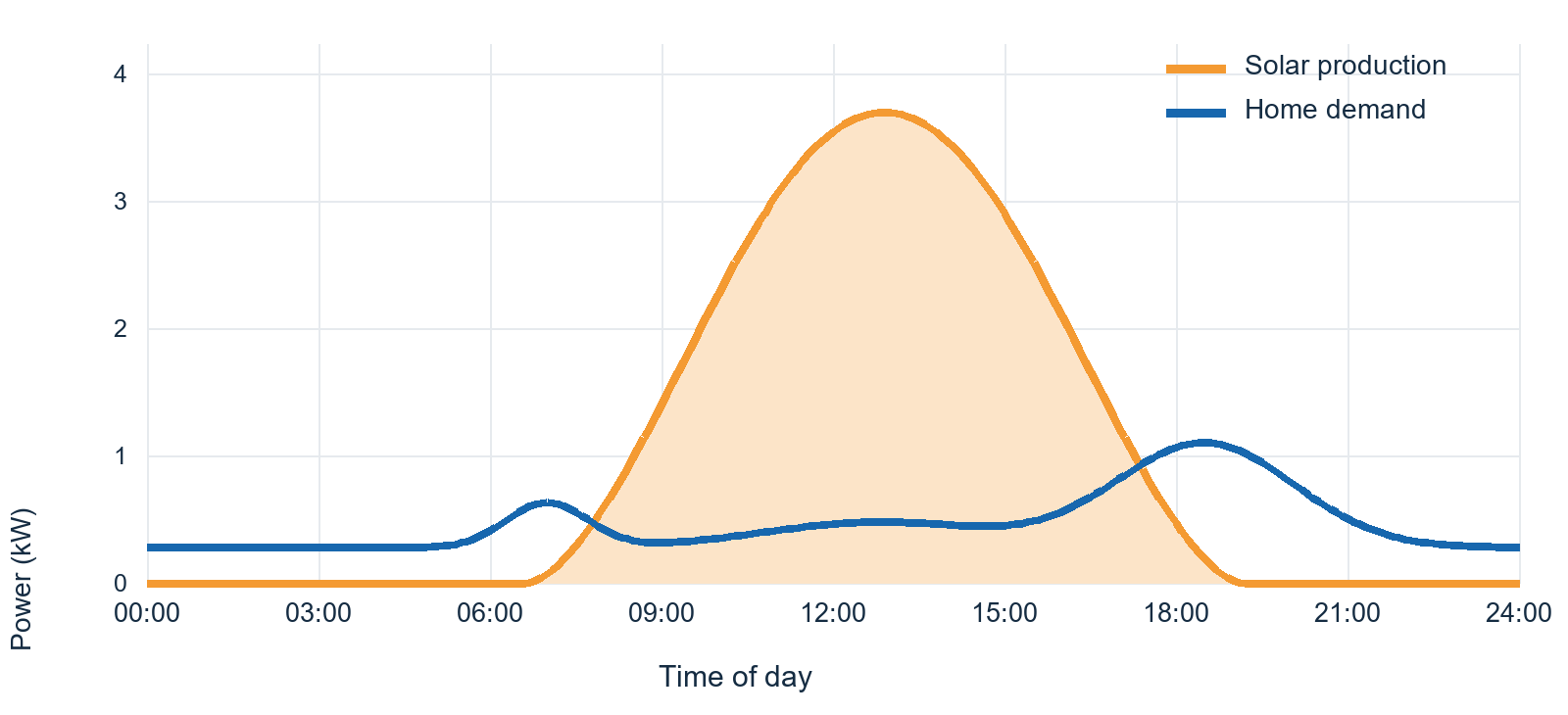
Suppose your solar panels produce 2,000 watts during the day while your appliances use 500 watts. Those 500 watts are direct self-consumption. Only the remaining 1,500 watts are exported to the grid. Later in the evening, when the panels produce nothing, you import electricity from the grid.
This distinction matters because directly used solar electricity never has to be bought first. That remains true after 2027. [1]
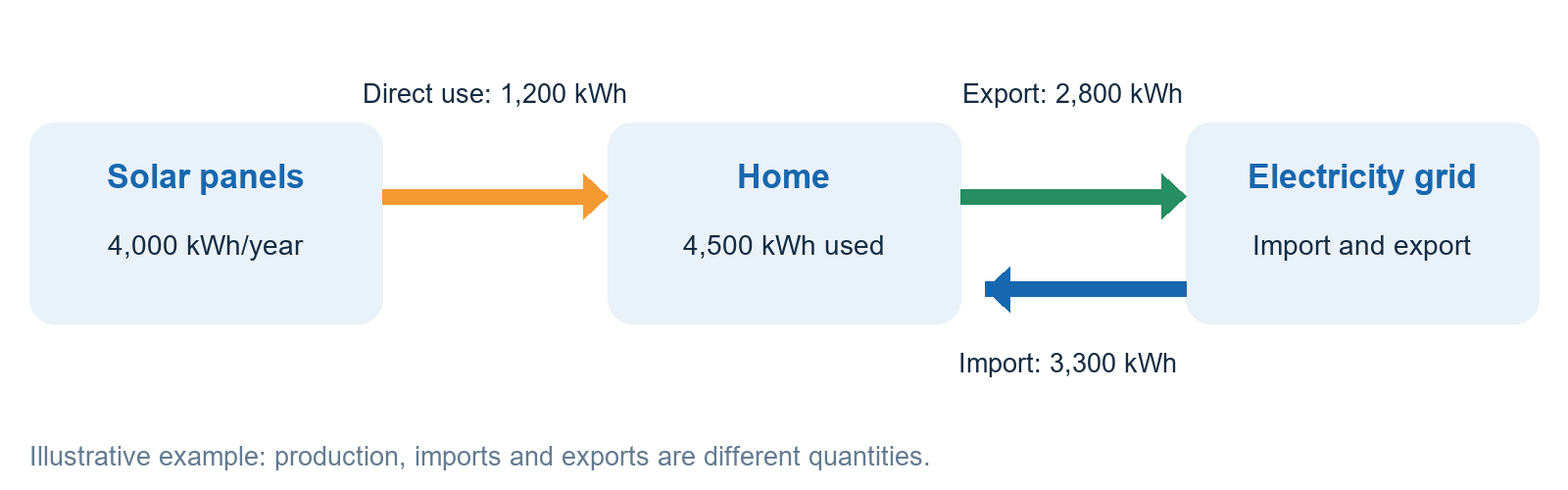
In our running annual example, production is 4,000 kWh: 1,200 kWh is used directly and 2,800 kWh is exported. The home uses 4,500 kWh in total and therefore imports 3,300 kWh from the grid.
Why is the scheme ending?
The net-metering scheme was intended to make buying solar panels attractive. Under net metering, a kilowatt-hour exported in summer was worth almost as much on your annual bill as one imported in winter. This shortened the payback period.
The government cites several reasons for ending the scheme: net-metering costs are partly spread across other customers, tax revenue is lost, and there is a desire for households to use more of their own solar electricity directly. Meanwhile, the number of solar panels has grown substantially. [1]
What is not happening?
- Your solar panels are not being banned.
- In principle, you can continue exporting electricity.
- You do not lose the advantage of direct self-consumption.
- VAT on the purchase and installation of residential solar panels does not automatically become 21% because net metering ends.
The statutory start date is 1 January 2027. There is no longer an annual phase-out; the net-metering scheme ends in one step. [1, 3]
Net metering up to and including 2026
Until 31 December 2026, electricity exported to the grid is offset on the energy bill against electricity imported, up to the amount you imported. This offsetting is called salderen in Dutch. It includes energy tax and VAT on the offset amount. [2]
If you import 2,500 kWh and export 2,500 kWh in a year, then, assuming one unchanged tariff, 0 kWh remains to be paid for at the variable supply rate. Fixed supply charges, grid-operator charges and any export charges still apply.
If you import 3,000 kWh and export 2,000 kWh, you pay for another 1,000 kWh in this simple example. If you export more than you import, you receive separate compensation for the excess. [2]
An important detail
With different tariffs during the year, and especially with dynamic contracts, the exact settlement can be more complicated. In those cases, check the terms and your final bill. A simple kWh sum explains the principle, not every contract detail.
What changes from 2027?
From 1 January 2027, kilowatt-hours will no longer be offset against each other. Your supplier will settle grid imports and exports separately. You will then pay energy tax and VAT on all electricity imported from the grid, and receive compensation for exported electricity. [1, 2]
Even if you export more solar electricity in a year than you import, the energy tax on imported electricity will no longer be offset. Exported electricity has its own revenue.
For a contract spanning the turn of the year, the supplier must treat the periods before and from 1 January 2027 separately. Any additional contractual rights depend on your terms. [2]
What makes up your electricity price?
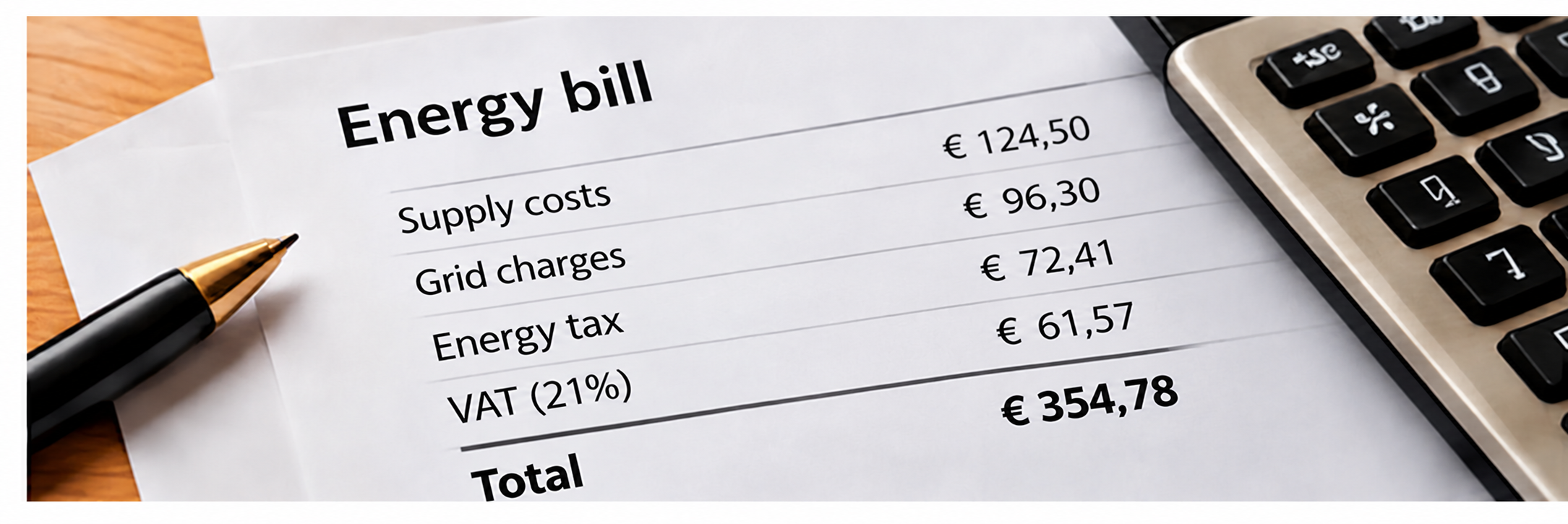
The price per kWh you pay is not just the price of electricity. You also pay taxes. In addition, there are charges unrelated to the number of kilowatt-hours used, such as fixed supply charges and grid-operator costs. The government describes these components separately. [4]
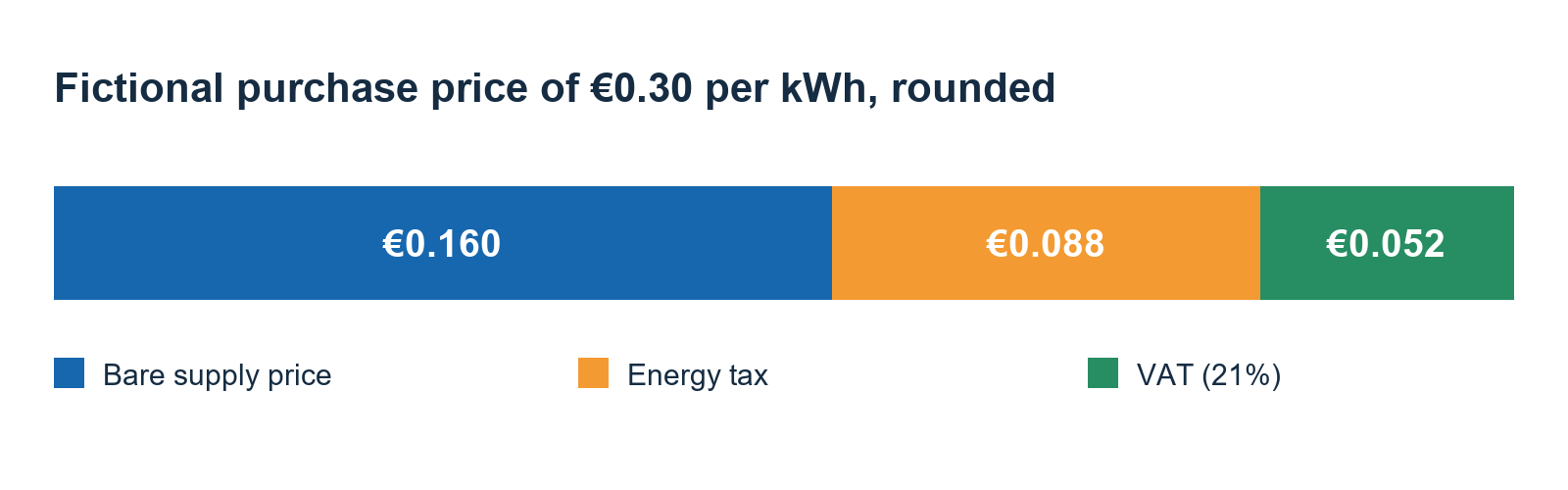
The image shows how a bare supply price of 16 cents, a fictional energy tax of 8.8 cents and 21% VAT add up to roughly 30 cents. The chosen tax amount is a calculation assumption and explicitly not the established rate for 2027.
What about fixed charges?
Fixed supply charges and grid-operator costs are separate from the per-kWh price. They do not disappear because your panels produce more than you import. After all, the grid operator still maintains the connection through which you both import and export electricity.
Energy tax in plain language
Energy tax is a tax on energy you buy from your supplier. On an energy bill, it often appears as an amount per kWh. From 2027, you pay it on all grid imports, even if you export an equal amount at other times. [2]
This does not mean the Dutch Tax Administration taxes every unit of electricity your solar panels generate. Electricity used directly in the home does not pass through the supplier as an import, so you do not pay the supplier energy tax on it.
For 2026, the Dutch government quotes approximately 11.1 cents per kWh including VAT for the first two consumption bands. Rates may change each year. That is why we use this figure only as a 2026 reference. [4]
Misconception: “My solar panels generate more than I use each year, so I never pay energy tax.” From 2027, that is incorrect: what matters is how much electricity you actually import from the grid.
VAT and the energy-tax reduction
Why is VAT charged on energy tax?
Dutch energy bills are subject to 21% VAT. VAT is also calculated on energy tax. That may feel like a tax on a tax, but it is how the bill is structured. [4]
What is the energy-tax reduction?
Households with an eligible electricity connection generally receive a fixed tax reduction on their energy bill. It is not a solar-panel subsidy or export compensation. People without solar panels may also receive it.
For 2026, the Dutch government quotes €629 including VAT as the reduction. The government sets the amount again each year. We deliberately do not enter a 2027 amount in our examples. [4]
And VAT on buying solar panels?
Since 2023, a zero VAT rate has applied in most normal residential situations to the supply and installation of solar panels on or near homes. That is separate from net metering. Not everything related to solar panels automatically qualifies for this zero rate; a standalone home battery, for example, does not. [5]
How much do you receive for exported electricity?
From 2027, you receive compensation for every kilowatt-hour exported. Its level depends on your contract and statutory rules. Until 1 January 2030, the statutory minimum compensation is at least 50% of the bare supply tariff, excluding energy tax and VAT. [1, 2]
That is different from 50% of your full consumer price. Suppose the bare tariff is 16 cents while you pay about 30 cents including taxes. Then 50% of the bare tariff is 8 cents, not 15 cents.
| Term | Fictional amount | Meaning |
|---|---|---|
| Bare supply price | €0.16/kWh | Supply excluding tax and VAT |
| Full consumer price | €0.30/kWh | Supply plus taxes |
| 50% of bare price | €0.08/kWh | Example calculation of minimum compensation |
Under dynamic contracts, the bare supply tariff may change every hour or quarter-hour. The eventual export compensation and application of the terms depend on the contract and applicable rules. Do not compare a single displayed rate in isolation.
Export charges: why do they exist?
Export compensation is money you receive for electricity. Export charges (terugleverkosten) are charges the supplier levies because you export it. They are two separate items on the bill.
Suppliers may levy such charges as long as they comply with the applicable rules. They can use different models, such as a rate for each exported kWh or tiered bands. According to ACM ConsuWijzer, where charges are arranged separately they are often calculated on the entire quantity exported. [2, 6]
For example, compensation might be 8 cents per kWh while export charges are 4 cents per kWh. In this example, you retain 4 cents per exported kWh. Other suppliers may use different amounts or calculation methods.
A statutory minimum compensation is not the same as a guaranteed net return. Export charges can consume a large part of the compensation and may even exceed it under some contracts. [2]
A complete calculation example
We use an average household with solar panels. To isolate the effect of the change in law, we keep the same fictional tariffs for both years. Real suppliers and prices will of course change.
| Item | Value |
|---|---|
| Total household electricity demand | 4,500 kWh per year |
| Total solar-panel production | 4,000 kWh per year |
| Used directly in the home | 1,200 kWh per year |
| Imported from the grid | 3,300 kWh per year |
| Exported to the grid | 2,800 kWh per year |
| Purchase price including taxes | €0.30 per kWh |
| Export compensation from 2027 | €0.08 per kWh |
| Export charges | €0.04 per exported kWh |
Up to and including 2026
Net metering: 3,300 − 2,800 = 500 kWh remaining. Variable import costs: 500 × €0.30 = €150. Export charges: 2,800 × €0.04 = €112. Total: €262 per year.
From 2027
Imports: 3,300 × €0.30 = €990. Export compensation: 2,800 × €0.08 = €224. Export charges: €112. Total: €878 per year.
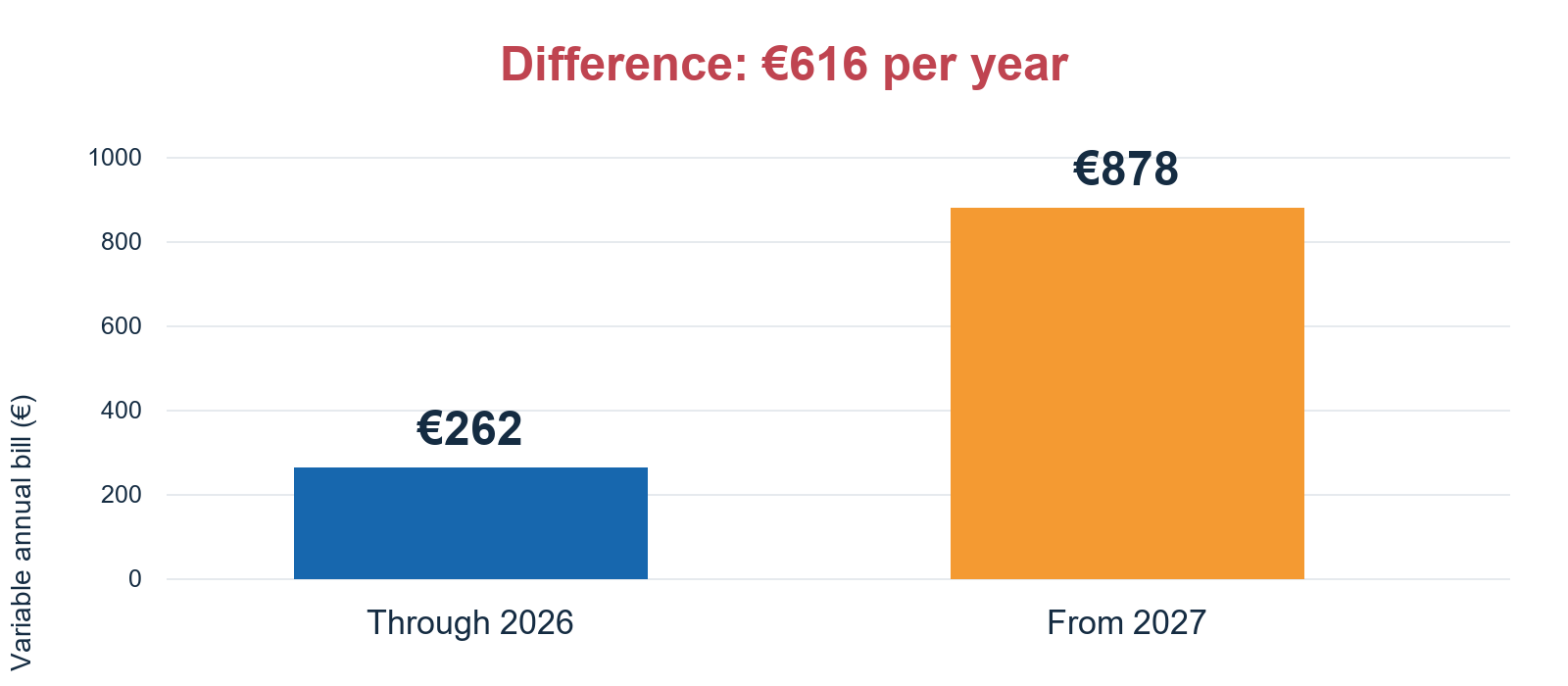
The difference is €616 per year. Both amounts exclude fixed charges, grid-operator costs, the energy-tax reduction, and the purchase or maintenance of the panels.
Are solar panels still worthwhile?
Yes. Existing solar panels still produce electricity that you do not have to buy. The financial benefit does become smaller if you export a lot to the grid and use little directly yourself.
For the household in the previous chapter, a home without solar panels would pay 4,500 × €0.30 = €1,350 in variable electricity costs. With solar panels, the fictional balance from 2027 is €878. That is still a benefit of €472 per year in this example, excluding the purchase price and other costs.
Whether new solar panels pay for themselves depends, among other things, on purchase price, yield, direct use, maintenance, inverter replacement, tariffs and export charges. A calculation using your own figures is therefore more useful than a general payback-time claim.
A better question than “Are solar panels still profitable?” is: “How much electricity can my household use at the times when the panels are producing it?”
Three households compared
Not every household has the same solar installation. A small system and a large system can work out very differently. This table presents three simplified profiles, again using the same fictional tariffs: 30 cents to buy, 8 cents in compensation and 4 cents in export charges per kWh.
| Profile | Grid import | Export | 2026 | 2027 |
|---|---|---|---|---|
| Small | 1,900 kWh | 1,600 kWh | €154 | €506 |
| Average | 3,300 kWh | 2,800 kWh | €262 | €878 |
| Large | 4,500 kWh | 3,700 kWh | €388 | €1,202 |
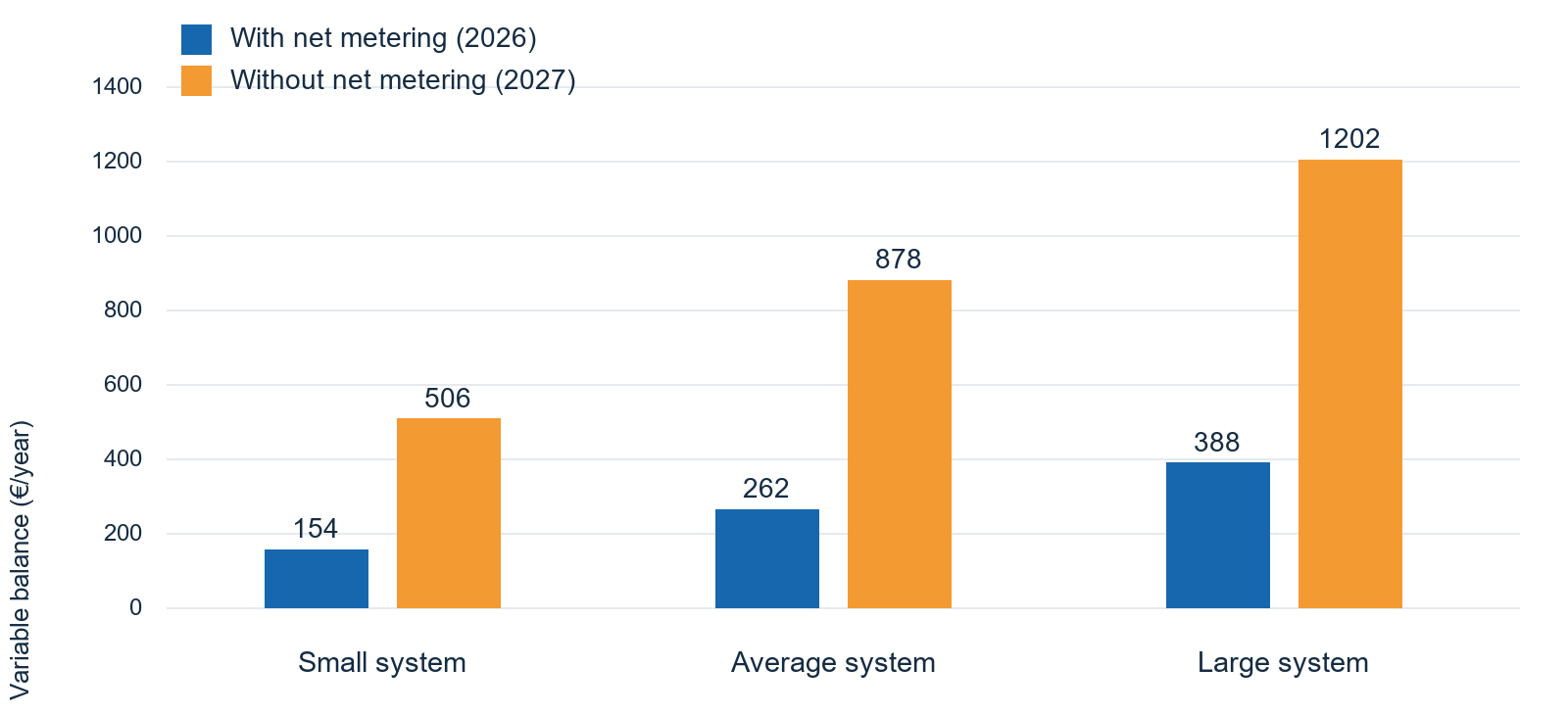
The largest absolute difference occurs for the household that exports a lot of electricity. This says nothing yet about its exact payback time, because purchase costs and direct self-consumption also matter.
Why self-consumption makes such a difference
The same number of solar panels can produce very different financial outcomes for two households. One uses electricity mainly during the day; the other needs most of it only in the evening. The number of panels alone therefore tells you little about the final energy bill.
Take another home using 4,500 kWh a year and generating 4,000 kWh. Suppose it directly uses 800, 1,200 or 2,000 kWh. All remaining kilowatt-hours are exchanged with the grid. Because production and total demand stay the same, this isolates the effect of when electricity is used.
| Direct self-consumption | Grid import | Export | Variable balance 2027 |
|---|---|---|---|
| 800 kWh (20% of production) | 3,700 kWh | 3,200 kWh | €982 |
| 1,200 kWh (30% of production) | 3,300 kWh | 2,800 kWh | €878 |
| 2,000 kWh (50% of production) | 2,500 kWh | 2,000 kWh | €670 |
These amounts follow from the same fictional prices. Moving from 20% to 50% direct self-consumption changes the result by €312 per year in this example, without adding a single panel. Such a percentage is not always achievable; roof orientation, being at home during the day, hot-water provision and an electric car all make a substantial difference.
Be careful with the term self-consumption. You can express it as a percentage of PV production (direct use divided by production). That is different from the percentage of total household demand met by solar electricity.
Fixed, variable or dynamic contract?
Fixed-price energy contract
Under a fixed-price contract, the supply price is usually fixed for an agreed period. Export compensation and charges have their own terms. Check specifically what your contract says about changes in 2027.
Variable-rate energy contract
Under a variable-rate contract, tariffs can change at agreed times. You may therefore pay or receive more or less than in the earlier examples. Always check when price changes take effect and how export compensation is determined.
Dynamic energy contract
Under a dynamic contract, market prices can vary by hour or quarter-hour. Sunny afternoons may produce lower or even negative market prices. The net price also depends on taxes, contract mark-ups and other charges. A negative market price does not automatically mean a negative net return for your panels.
When comparing contracts, always check five things together: the purchase price, export compensation, export charges, fixed supply charges and any time-dependent mark-ups.
Direct self-consumption becomes much more important
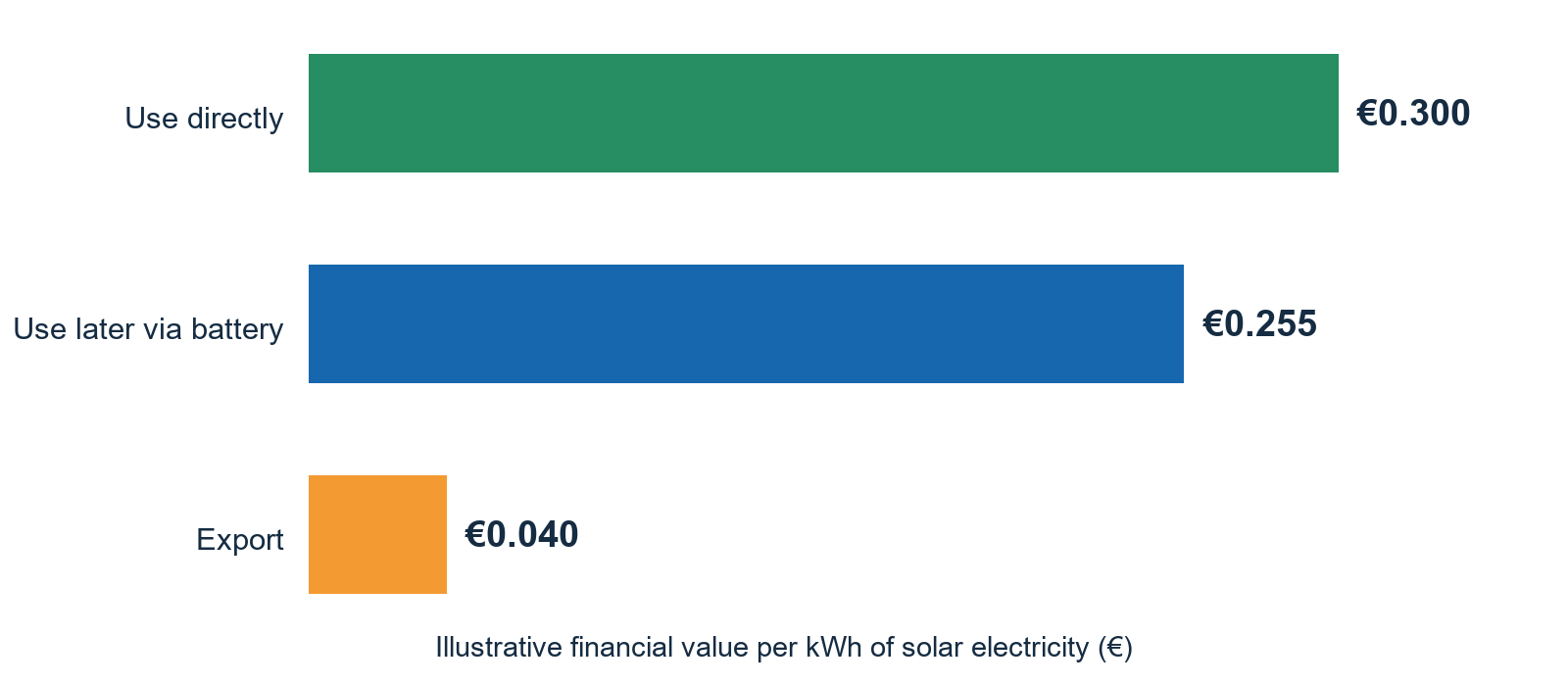
When you use a kilowatt-hour of solar electricity directly, you do not have to buy it. In our fictional example, that saves about 30 cents. If you export the same kilowatt-hour, you receive 8 cents but pay 4 cents in export charges, leaving 4 cents net.
Using a kilowatt-hour directly is thus worth 26 cents more in this example than exporting that kilowatt-hour and later importing another from the grid. In reality, the difference depends on your contract.
What helps in practice?
- Run the dishwasher during the day if a wash is needed anyway.
- Use a suitable boiler or heat pump more intelligently, without neglecting comfort or hygiene.
- Where possible, charge an electric car when there is surplus solar electricity.
- Avoid wasting energy: consuming extra electricity solely because the sun is shining does not save money.
What does shifting consumption actually save?
Suppose the same household uses 500 kWh more of its own production directly each year, for example by moving electric-car charging or dishwasher use to sunny hours. Total production and annual household demand stay the same.
Grid import then falls from 3,300 to 2,800 kWh, and export from 2,800 to 2,300 kWh. The variable bill becomes 2,800 × €0.30 − 2,300 × €0.08 + 2,300 × €0.04 = €748.
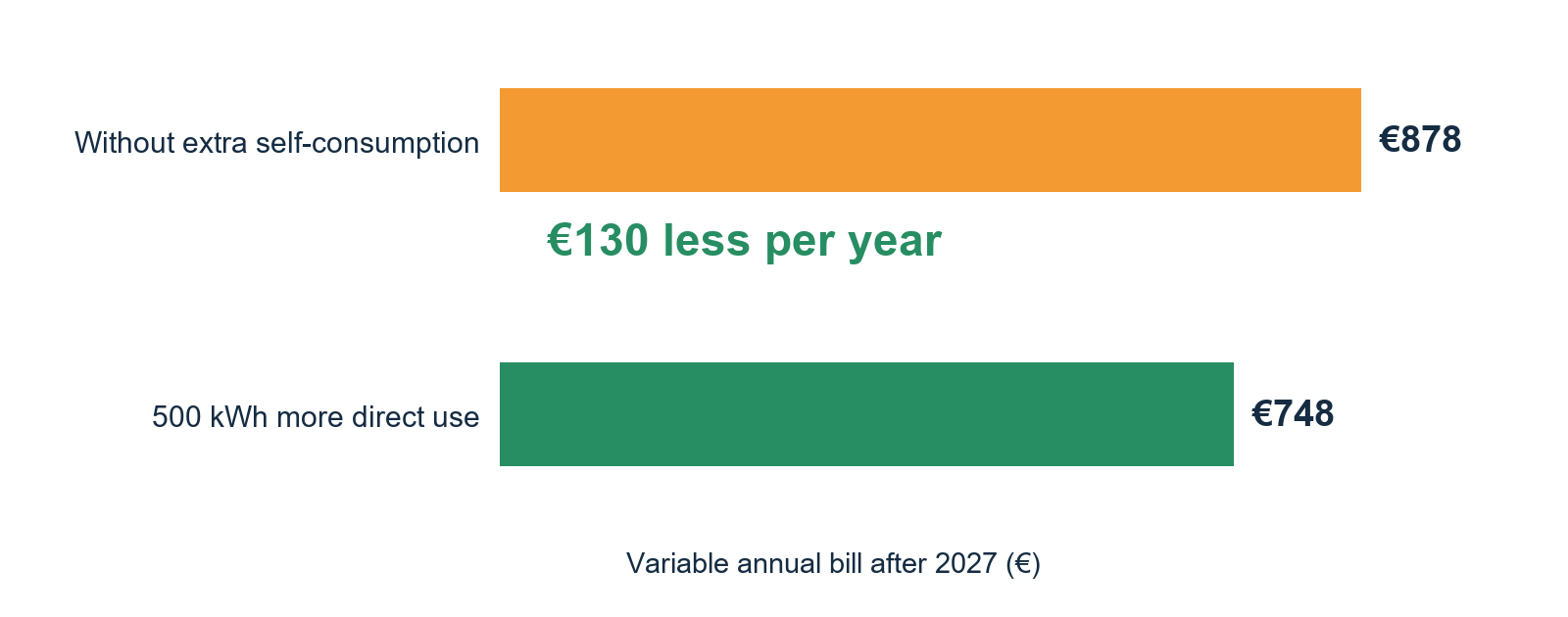
Saving in this example: €130 a year. The result changes if export charges use fixed bands or if import and export prices depend on the time of day.
A home battery: worthwhile or not?
A home battery can store surplus daytime solar electricity for the evening, avoiding later grid imports. But the battery costs money, loses energy during charging and discharging, and cannot deliver an unlimited number of cycles.
In our example, using one kWh directly saves about 30 cents. If you first send one kWh through a battery with 85% round-trip efficiency, about 0.85 kWh is available later. That avoids about €0.255 of grid imports. If that kilowatt-hour would otherwise have earned a net €0.04 from export, the additional gross saving is about €0.215 per stored kWh.
A 5 kWh battery completing, for example, one full cycle on 180 days processes at most about 900 kWh of solar electricity in that example year. At the fictional advantage, that is about €194 gross. The investment, degradation and any additional system costs still have to be deducted. A battery is therefore not automatically profitable.
Switching off solar panels: a good idea?
Some solar owners switch their installation off when export compensation is low or negative. Under particular contract terms that can make financial sense, but “the electricity price is negative” is not enough information on its own.
If you switch off the entire PV installation, you also lose the electricity that could have been used directly in the home at that moment. That can cancel out the apparent gain from avoiding export.
Where a system can reduce output without shutting down completely, power limiting can sometimes be more suitable. This requires compatible inverter control and a safe, properly designed installation. Have any changes to the AC installation performed by a qualified installer.
Do not switch off solely on the basis of one bare wholesale price. Include your contract compensation, export charges, direct self-consumption and the consequences of shutting down in the calculation.
Smart measurements and Home Assistant
You do not need a complete smart home to benefit from the new rules. A smart meter, a clear energy contract and insight into your solar production already go a long way. Home Assistant can make the picture more precise for those who use it.
Which data are useful?
- Total solar-panel production (inverter, ECU or PV meter).
- Current grid imports and exports through P1 or another suitable meter.
- The current supply tariff and relevant contractual export compensation.
- Export charges and fixed charges from your contract.
- Power or energy use of large controllable appliances, such as a boiler or electric car.
With these, you can calculate direct self-consumption as PV production minus export, provided your measurement signals are correct and simultaneous and there are no other generators or storage losses to account for. You can then see which appliances fit well into sunny hours.
Note that a dashboard showing only net power in the meter cabinet does not automatically tell you how much your panels produce. Nor does a price sensor usually include all taxes and supplier charges.
Ten common misconceptions
- “From 2027, my panels will not be allowed to export.” Incorrect. In principle, export remains possible.
- “I will pay tax on all electricity generated.” Incorrect. You do not pay the supplier energy tax on solar electricity used directly.
- “I will receive exactly half of the price I pay per kWh.” Incorrect. The statutory minimum until 2030 is linked to the bare tariff.
- “Export charges apply only to my surplus.” Often not. Check total exports and your contract terms.
- “My energy bill becomes zero if annual production equals annual use.” No. Timing and the separate grid flows determine the result.
- “The fixed energy-tax reduction disappears with net metering.” It is a separate scheme with amounts set each year.
- “The zero VAT rate on solar panels also ends in 2027.” The purchase arrangement is separate from net metering.
- “A home battery always pays for itself quickly.” Not automatically; losses, investment and use determine the outcome.
- “A negative wholesale price means I must switch off my panels.” Not without calculating all contract costs and your own consumption.
- “If I use more electricity, I save money.” Shifting useful consumption can save money; wasting energy never does.
How to read the annual bill from 2027
An energy bill can contain dozens of lines. To check whether the main amounts make sense, you need not understand every small item immediately. Start with the quantities of electricity, then check variable prices, and finally compare fixed charges and the tax reduction.
For the example household, the bill contains two different quantities: 3,300 kWh imported and 2,800 kWh exported. The 4,000 kWh produced will usually be visible in the inverter app, not as a separate quantity on the supplier's bill.
| Item on the energy bill | Check |
|---|---|
| Electricity purchased | Imported kWh × contract tariff |
| Energy tax + VAT | Check the tax base and applicable year |
| Export compensation | Exported kWh × contract compensation |
| Export charges | Check the kWh rate, band or fixed agreement |
| Fixed charges and grid operation | Consider separately from net annual consumption |
| Energy-tax reduction | Fixed discount, not export compensation |
If your contract has changing tariffs, different import and export periods may be settled at different rates. Keep your tariff sheets and check that the periods shown match the bill.
For a bill spanning the transition into 2027, the supplier must split imports and exports into the parts before and after the year boundary. This is not an extra tax, but a necessary administrative separation. [2]
How to check your own situation
Use your annual bill, your energy contract and your inverter data. First write down the following figures. Put general advertising claims and average payback times aside for the moment.
| Item | Where to find it |
|---|---|
| Annual grid import in kWh | Annual bill / P1 meter |
| Annual export in kWh | Annual bill / P1 meter |
| Annual PV production in kWh | Inverter app / production meter |
| Bare supply tariff and all-in tariff | Contract / tariff sheet |
| Export compensation and charges | Contract / annual bill |
| Fixed supply charges and grid operation | Annual bill |
Then calculate direct self-consumption as production minus exports. Compare suppliers on the total annual bill, not on a single rate. With a dynamic contract, include the relevant prices for each period.
A supplier must split the period before and after 1 January 2027 on the bill. Check that transition carefully and keep your previous contract terms. [2]
What can you do in the coming months?

- Understand your figures. Check grid imports, exports, production and direct self-consumption.
- Review your contract. Check fixed rates, dynamic periods, export compensation, export charges and cancellation terms.
- Use electricity when it serves a purpose. Where possible, schedule appliances for sunny periods.
- Do not buy a home battery too hastily. Calculate the return, losses, lifespan and purchase cost.
- Do not focus only on 2026. The year 2027 will have its own tax rates and possibly different supplier terms.
The biggest saving is usually not found in one miracle device. Knowing your own consumption, comparing contracts carefully and scheduling existing appliances sensibly is a better starting point.
Conclusion: what remains?
The statutory net-metering scheme ends on 1 January 2027. Electricity exported in summer will therefore no longer automatically be offset against electricity bought in winter. You pay energy tax and VAT on grid imports and receive separate compensation for exports. Any export charges can reduce the net advantage.
Your solar panels do not stop working or lose their entire value. You do not have to buy electricity used directly from them, so it remains valuable. The financial balance does become more individual: contract, production profile, grid import, direct use and investment determine whether an installation pays off.
The essence in one sentence: after 2027, the key is less how much electricity you generate over a year, and more how much solar electricity you can use yourself at the right time.
This article describes the Dutch rules as known on 18 October 2026. Future tariffs and individual contract terms may differ. It is public information, not personal tax, legal or financial advice. [1–6]
Official sources and further reading
- [1] Dutch government — Net-metering scheme ends in 2027
- [2] ACM ConsuWijzer — Net metering and exporting electricity
- [3] Overheid.nl — Act ending the net-metering scheme
- [4] Dutch government — Structure of the energy bill
- [5] Dutch government — Zero VAT rate for solar panels
- [6] ACM — Study of solar export charges
Accuracy note: facts established by law are sourced from the Dutch government, ACM and legislation. All example amounts for 2027 are fictional and deliberately do not use predicted tariffs. This publication contains illustrative, digitally generated photographs and original diagrams.