

The best filament is not simply the one with the highest tensile-strength number. A part can fail from heat, impact, creep, UV, moisture or wear. Start with its function, environment and the printer you actually own.
A phone holder faces different conditions from a gear, cable grommet, motor bracket or outdoor sensor enclosure. Ask what the part must endure over its entire service life, not just the load it survives today. Material choice is therefore largely a choice about the most likely failure mode.
Material selection starts with application, load and printability.
Which properties matter?
Stiffness describes how much a part bends; toughness how much energy it absorbs before breaking. In use, heat resistance is often about heat deflection and creep under load, not merely melting point. Outdoor parts face UV, weather and temperature cycles; moving parts face friction and wear. Chemical resistance, moisture uptake, layer bonding and printability also belong in the choice. Use the technical datasheet (TDS) of the exact filament for numeric properties; brands, colours and additives differ.
| Property | Practical question |
|---|---|
| Stiffness | How much does the part bend under load? Stiff does not automatically mean tough. |
| Toughness and impact | How much energy can it absorb before cracking or breaking? |
| Temperature | When does it deform under load, not merely when does it melt? |
| Creep | Does sustained load slowly deform it, particularly in heat? |
| UV and weather | Can it withstand sunlight, moisture and outdoor temperature cycles? |
| Chemical resistance | Can oil, cleaners, fuel or solvents damage it? |
| Wear and friction | Will it work in sliding surfaces, gears, hinges or guides? |
| Moisture uptake | Does the filament change during storage or printing? PA/nylon and support materials are sensitive, and wet PETG can also deteriorate. |
| Printability | Can your printer handle warping, bed adhesion, nozzle temperature and enclosure requirements? |
Practical selection: start with the likely failure mechanism rather than the highest tensile strength. A continuously clamped part may deform by creep; an outdoor enclosure must withstand weather; an impact-loaded part needs toughness. Alongside the material datasheet, examine print orientation, layer adhesion and part geometry. Testing a solid specimen does not automatically describe an FDM-printed part.
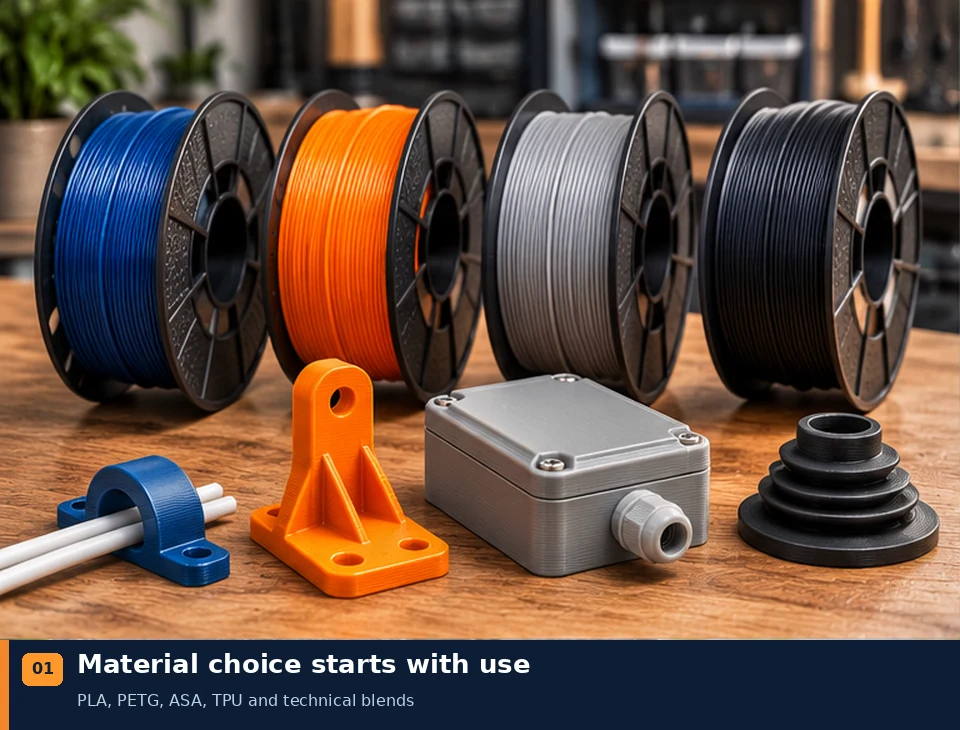
Every material comparison is indicative. Formulations vary considerably among manufacturers: a comparison chart is not a material certificate. Use the chosen blend's TDS for exact thermal and mechanical values.
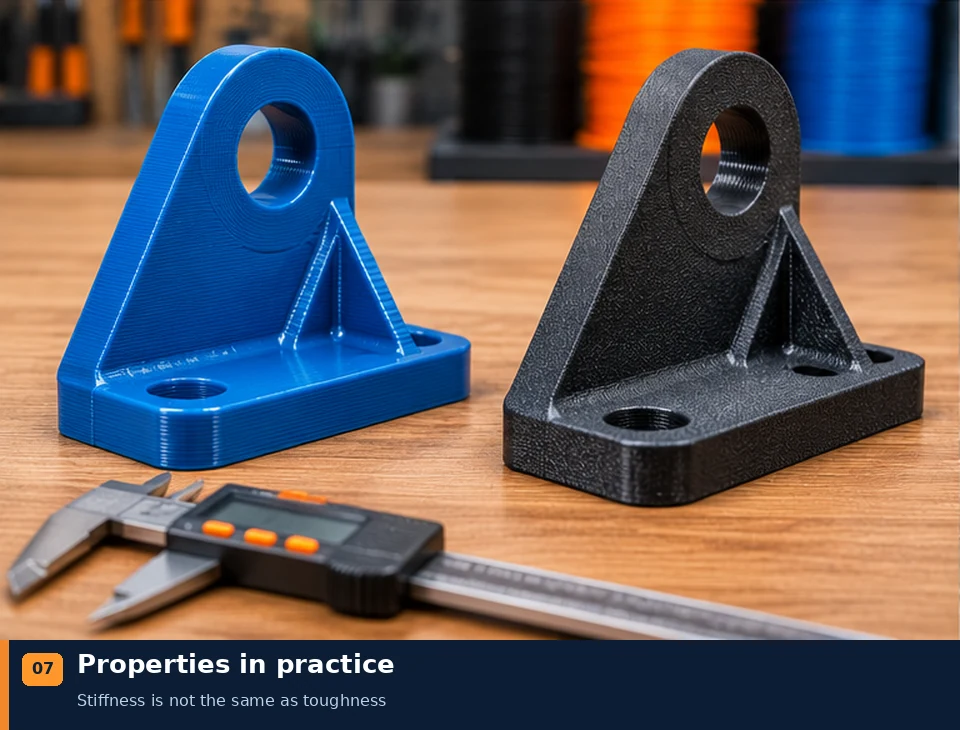
PLA and PETG/PCTG
PLA prints easily, warps little and produces sharp detail. It suits prototypes, display pieces, jigs, enclosures and many indoor parts at room temperature. It is not a universal structural plastic: a bracket in a hot car or a permanently stressed clip may deform. PLA Matte, Silk, Tough and CF are not interchangeable variants; treat each as its own profile.
When to choose PLA, and when not to
Choose PLA for prototypes and appearance parts, for parts that mainly need stiffness and dimensional stability at room temperature, and when easy, reliable printing matters more than maximum heat or impact resistance. It is not my first choice for parts that stay warm for long periods, remain outdoors in sun and weather for years, or repeatedly take heavy impacts. A snap-fit may work in a specifically tough PLA blend, but do not assume every PLA will behave that way. Matte, Silk, Tough and CF additives can affect flow, layer bonding, stiffness and brittleness as well as appearance.
PETG is often the next step for functional indoor parts. It is generally tougher and more resistant to moisture and heat than standard PLA, but may string more and bond too firmly to some print surfaces. It is a practical middle ground for cable management, brackets, workshop parts and humid rooms. PCTG may offer additional toughness or impact resistance, but the benefit depends on the exact blend.
A poorly tuned PETG profile may give a less tidy finish. PCTG is related to PETG, but its name alone guarantees no particular impact performance: compare manufacturer datasheets. PETG is often a useful starting point for electronics enclosures and parts that need to flex a little without the demanding chamber conditions of some engineering filaments.
Example: indoor bracket. PLA is a good starting point for a stiff, lightly loaded part that stays cool. PETG is often worth considering if the component needs some flex or operates in a humid location. Neither is automatically suitable for a constantly stressed clip or a hot car: check the exact filament’s creep and thermal properties.
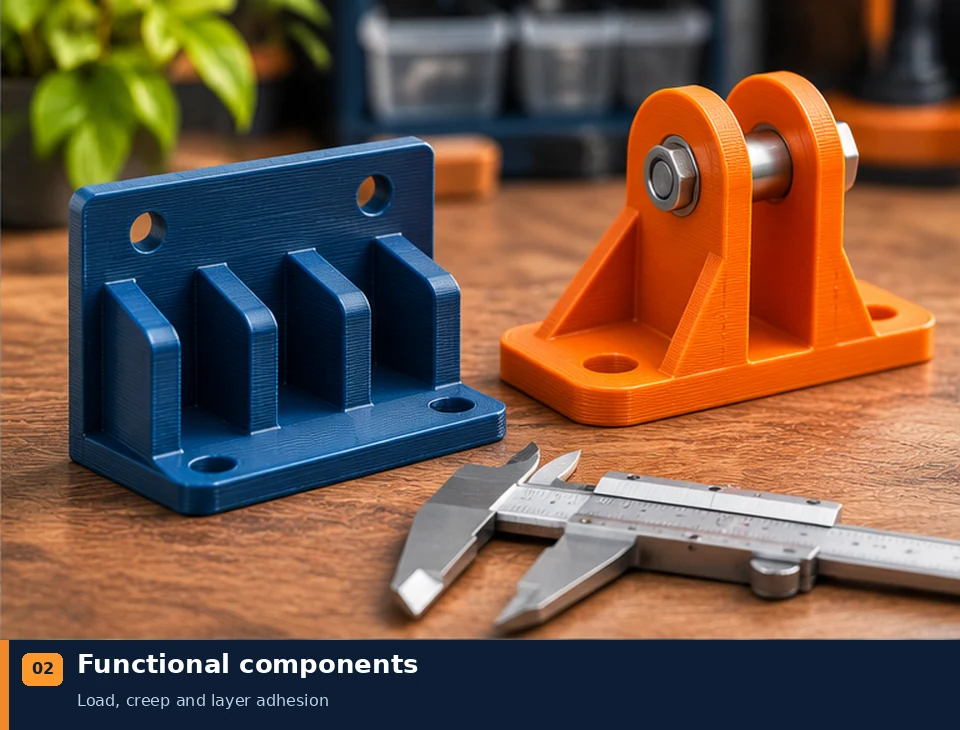
ABS, ASA and flexible filaments
ABS offers greater temperature resistance and toughness but shrinks noticeably. Large parts often need a stable, warm, draft-free environment. ASA has similar processing demands with better UV and weather resistance; it is often the more logical choice for an outdoor enclosure or sensor mount. An enclosure is not a reason to print PLA thoughtlessly in an extremely hot chamber.
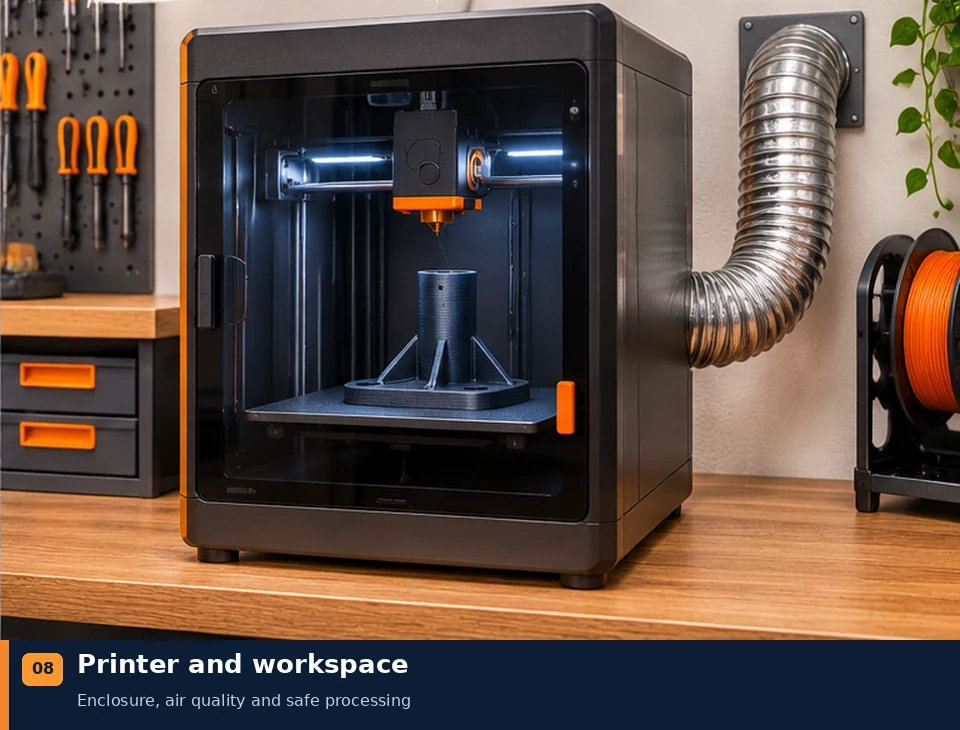
Ventilation when printing ABS or ASA: an enclosure mainly helps control drafts and print temperature. It does not make fumes or ultrafine particles harmless. Use a well-ventilated workspace with an appropriate extraction/filtration strategy and avoid prolonged exposure. Avoid directly blowing cold air onto the part. A printed outdoor sensor enclosure is not automatically watertight either: seams, cable glands, seals and layer structure also matter.
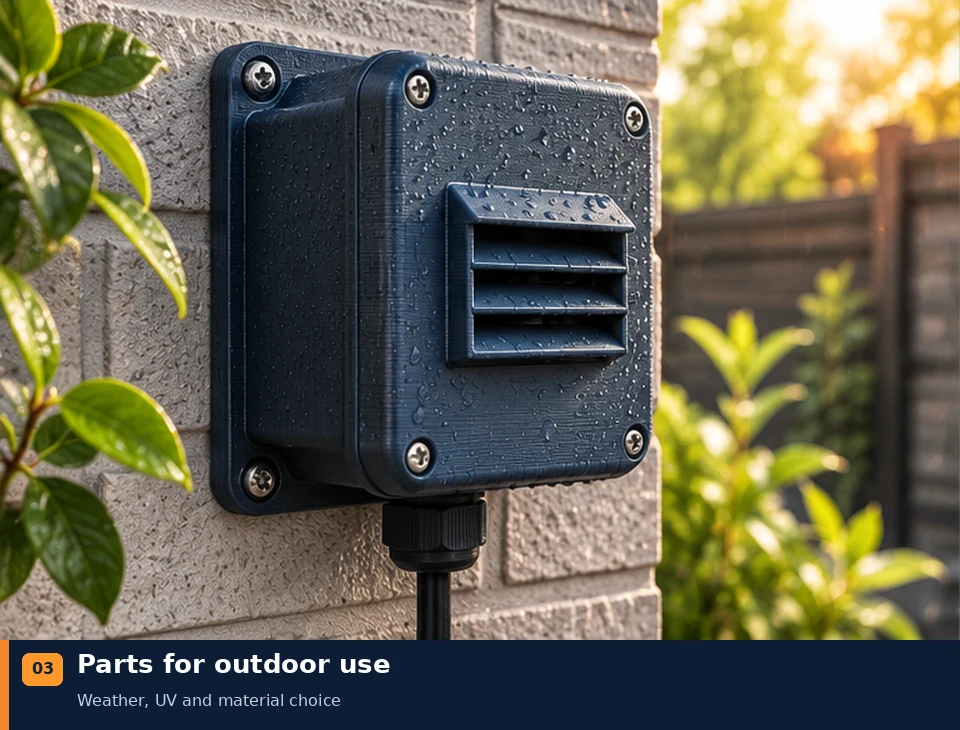
ABS is a classic engineering plastic, but its cooling shrinkage makes a stable environment important for larger prints. ASA is often the better option for outdoor enclosures and mounting brackets because of its UV and weather resistance. An enclosure does not help without limits: excessive chamber heat can cause problems for low-temperature plastics, including some PETG grades.
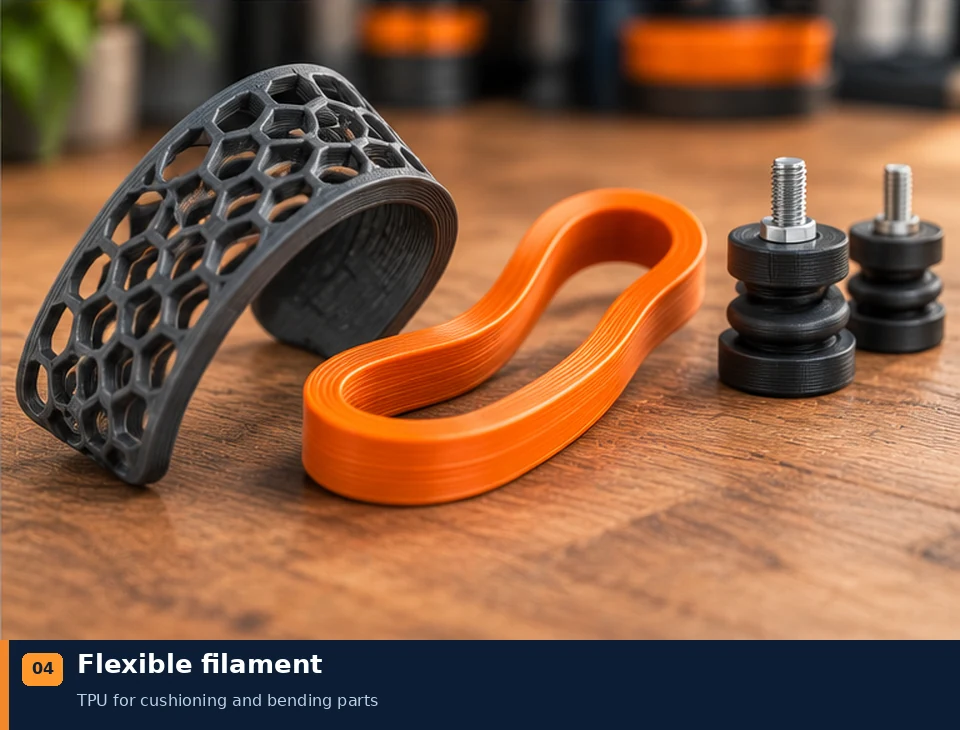
TPU/TPE is for bending and cushioning parts such as feet, bumpers, covers and cable grommets. Shore hardness describes hardness, not the whole mechanical behaviour. Softer filament needs a controlled path, slower printing and careful retraction. Check feeder or AMS compatibility; do not force flexible filament through an unsuitable system.
Seal-like shapes and flexible couplings are other possible uses. Shore hardness does not tell you everything about the strength or how easily that particular filament travels through your extruder. Multi-material systems may have explicit restrictions for flexible materials; verify both the filament variant and feeder before printing.
P1S with original AMS: do not automatically feed ordinary soft TPU through a standard AMS. Use a specifically approved filament variant or an appropriate external feed path; always check current AMS/filament compatibility. The label TPU does not guarantee successful feeding. Shore A hardness describes only one aspect of behaviour.
PA/nylon, PC and fibre-filled materials
PA is tough and wear-resistant for mechanical parts, but highly hygroscopic. Moisture can cause bubbles, poor extrusion and inconsistent properties. A dryer and dry printing process are often part of the job. Unfilled PA can be flexible; PA-CF or PA-GF is stiffer, more dimensionally stable and more abrasive. It is not simply 'stronger nylon'.
Polyamide also offers useful fatigue resistance. Absorbed moisture can produce steam bubbles during printing, erratic extrusion, poor surfaces and inconsistent mechanical behaviour. For PA, a dryer is often a necessary part of the process. Fibre filling changes the balance: more stiffness and often better print-time dimensional stability come with nozzle abrasion and potentially different failure behaviour.
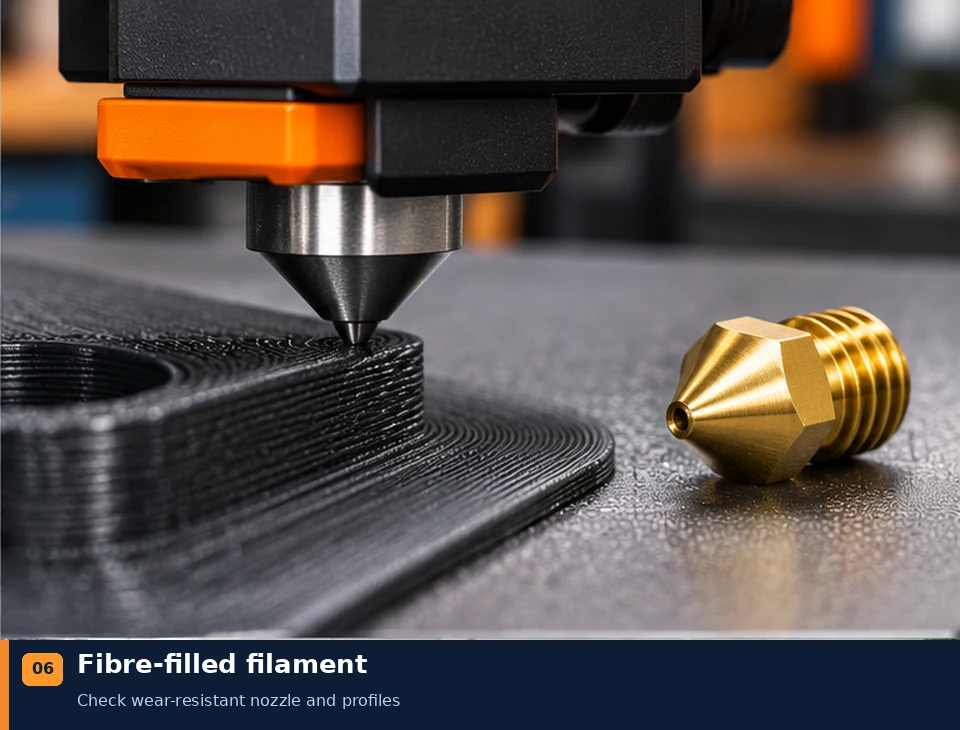
PC can meet demanding heat and toughness requirements but needs a suitable hotend, heated bed, adhesion and often a controlled chamber. PC blends vary greatly. Carbon- or glass-fibre-filled filaments often increase stiffness and reduce warping but can become more brittle or weaken Z bonding. They wear soft nozzles: check the recommended wear-resistant nozzle and minimum diameter.
Polycarbonate can be highly tough and heat resistant, but the exact blend determines what is necessary and achievable. CF and GF filaments contain short carbon or glass fibres in a plastic matrix. These may create a technical matte finish, greater stiffness and less warping. They are also abrasive: a standard brass nozzle can wear quickly. A rigid CF clamp does not necessarily spring back better than an unfilled one and may break sooner on impact or along layer lines.
Engineering families such as PET-CF, PA-CF/GF, PPA-CF and PPS-CF quickly raise hardware and drying demands. A nominal nozzle-temperature rating is insufficient: bed, chamber, filament path, volumetric flow and safe processing must also fit.
| Family | Strength | Typical considerations |
|---|---|---|
| PET-CF | Stiff, relatively dimensionally stable and sometimes good heat properties. | Abrasive; high nozzle temperature, suitable profile and drying. |
| PA-CF/PA-GF | Tough base plastic combined with higher stiffness. | Very hygroscopic and abrasive; drying and enclosure often important. |
| PPA-CF | Very high technical performance may be possible. | Demanding process; not for every printer. |
| PPS-CF | Potential for high temperature and chemical resistance. | Very high printing temperatures and specialised hardware. |
Fibre-filled does not necessarily mean stronger. CF/GF can increase stiffness and reduce warping, but impact resistance, fatigue behaviour and Z-direction bonding may become worse. Use a wear-resistant nozzle suited to the filament and wear-resistant drive components where required; check nozzle diameter and material-temperature limits. A P1S is not automatically suitable for every PPA/PPS or other high-temperature blend: verify nozzle, bed, chamber and temperature limits against current manufacturer specifications.
Drying, storage and printer checks
Use the manufacturer's drying temperature and duration; too much heat can deform the spool or filament. Silica keeps dry material dry but does not rapidly recover soaked nylon. For long prints, make sure the filament can stay dry throughout.
Keeping dry is different from active drying. Desiccant in an airtight box mainly helps preserve the condition of already dry filament. Wet PA/TPU needs manufacturer-specified drying at a temperature that both the filament and spool tolerate. Highly hygroscopic material may need a dry feed path throughout a long print. Never copy a generic drying temperature across brands and blends.
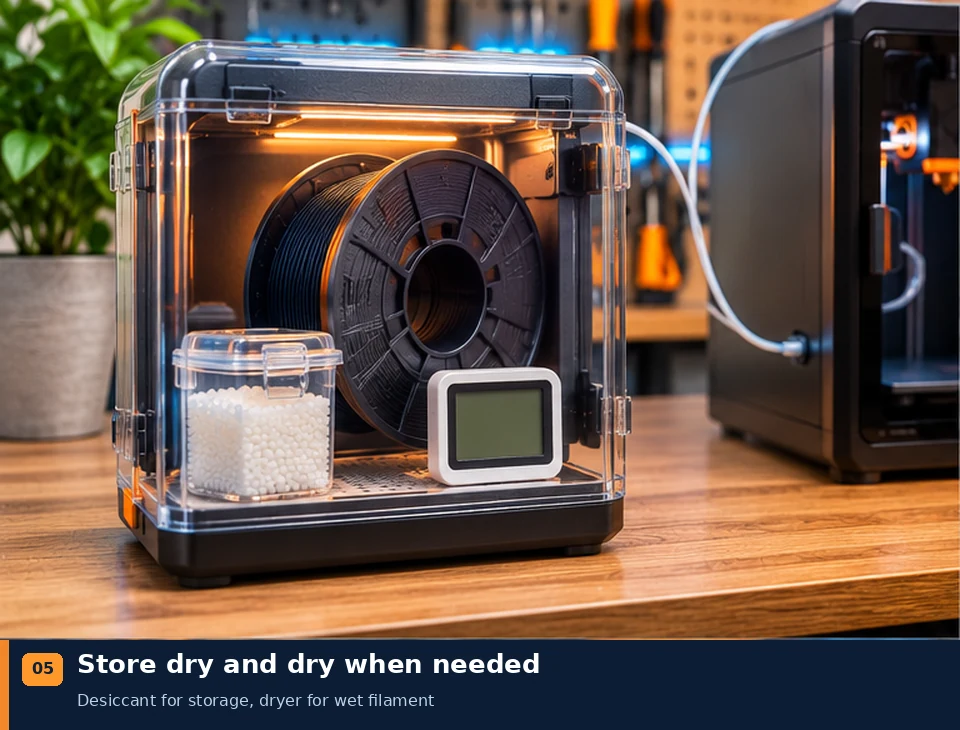
Too low a drying temperature removes little moisture. With engineering filaments, moisture control is part of printing as well as storage. A silica sachet helps keep already dry material dry; it will not fully restore a wet PA/nylon spool in a few hours.
Also ask whether the hotend can maintain the temperature continuously at the required flow, whether the bed is hot and even enough, whether an enclosure is needed, whether the nozzle resists abrasion and whether the filament path is suitable. Briefly reaching one specified temperature does not make a printer suitable for the material.
| Hardware question | Why it matters |
|---|---|
| Can the hotend continuously hold the required temperature? | Stable flow at the intended speed matters more than a brief peak. |
| Can the bed stay hot and even? | Temperature gradients can cause warping. |
| Is an enclosure needed? | ABS, ASA, PC and many PA blends benefit from fewer drafts and a warmer environment. |
| Is the nozzle wear-resistant? | CF, GF, glow and some other filled filaments abrade soft nozzles. |
| Is the filament path suitable? | Soft TPU and brittle material can have trouble in long or complex feeders. |
| Can the filament stay dry during a long print? | Particularly important for PA, PVA/BVOH and some engineering materials. |
Quick selection guide
| Application | Sensible starting point | Watch for |
|---|---|---|
| Display or prototype | PLA | Ease and detail. |
| Functional indoor part | PETG or tough PLA blend | Load and heat still matter. |
| Outdoor enclosure | ASA | UV, weather and enclosure. |
| Warm functional part | ASA, PC or suitable engineering blend | Read the TDS. |
| Flexible or cushioning part | TPU | Filament path and feeder compatibility. |
| Wear or mechanical hinge | PA/blend | Drying matters. |
| Stiff technical bracket | Suitable CF/GF composite | Abrasion and possible brittleness. |
- Indoor decorative object or cool prototype: start with PLA.
- Functional indoor part with some flex or humidity: consider PETG/PCTG.
- Outdoor UV and weather exposure: consider ASA, but also check enclosure sealing.
- Damping, bumper or flexible grommet: TPU with a compatible filament path.
- Wear or heavily loaded parts: evaluate a specific PA/PC/composite blend after reading its TDS and checking printer compatibility.
Do not turn these into a universal ranked-material chart. They are starting points, not certification or guaranteed strength.
Define environment and load first, select a material family, read the exact TDS, check printer hardware and test a sample under real operating loads. 'CF is always stronger', 'dry straight from the package' and 'my nozzle gets hot enough' are not reliable selection rules. Do not use an unvalidated hobby print as a safety-critical component.
Common mistakes
- 'CF is always stronger.' Fibres often mainly increase stiffness; impact behaviour and Z strength may get worse.
- 'ASA is only expensive outdoor PLA.' Its processing, shrinkage, chamber demands and mechanical behaviour are materially different.
- 'If my nozzle gets hot enough, my printer can handle this plastic.' Bed, chamber, hotend flow, wear-resistant nozzle, filament path and drying also matter.
- 'Dry from the package means dry enough.' Production, transport and storage may already have introduced moisture.
- 'High tensile strength means the best material.' Impact, creep, heat, UV, fatigue or weak layer bonding can cause failure first.
Decision procedure and sources
- Define the environment: indoor/outdoor, temperature, water, UV and chemicals.
- Define the loading: static load, impact, bending, fatigue, wear or flexibility.
- Choose the material family that addresses the likely failure mode.
- Read the exact filament's TDS, including HDT/Vicat, impact value, modulus, tensile strength and drying guidance.
- Check the printer's nozzle, bed, enclosure, feeder and maximum volumetric flow.
- Make a small trial print and test it under real loads before trusting a critical part.
Material properties differ by manufacturer, colour, additives and test method. This comparison draws on the Bambu Lab Filament Guide and Prusa’s Filament Material Guide as starting points. The current technical datasheet (TDS) of the exact filament remains authoritative for numeric properties and drying conditions. Material comparisons are indicative and do not certify home-printed components.