
Many people assume that a smart meter “settles” energy per phase. In practice, that is not how it works. Especially on a three-phase connection, you may export on one phase while importing on another at the very same moment. This article explains in plain language what happens, why your inverter app often shows something different from your energy bill, and why phase distribution matters.
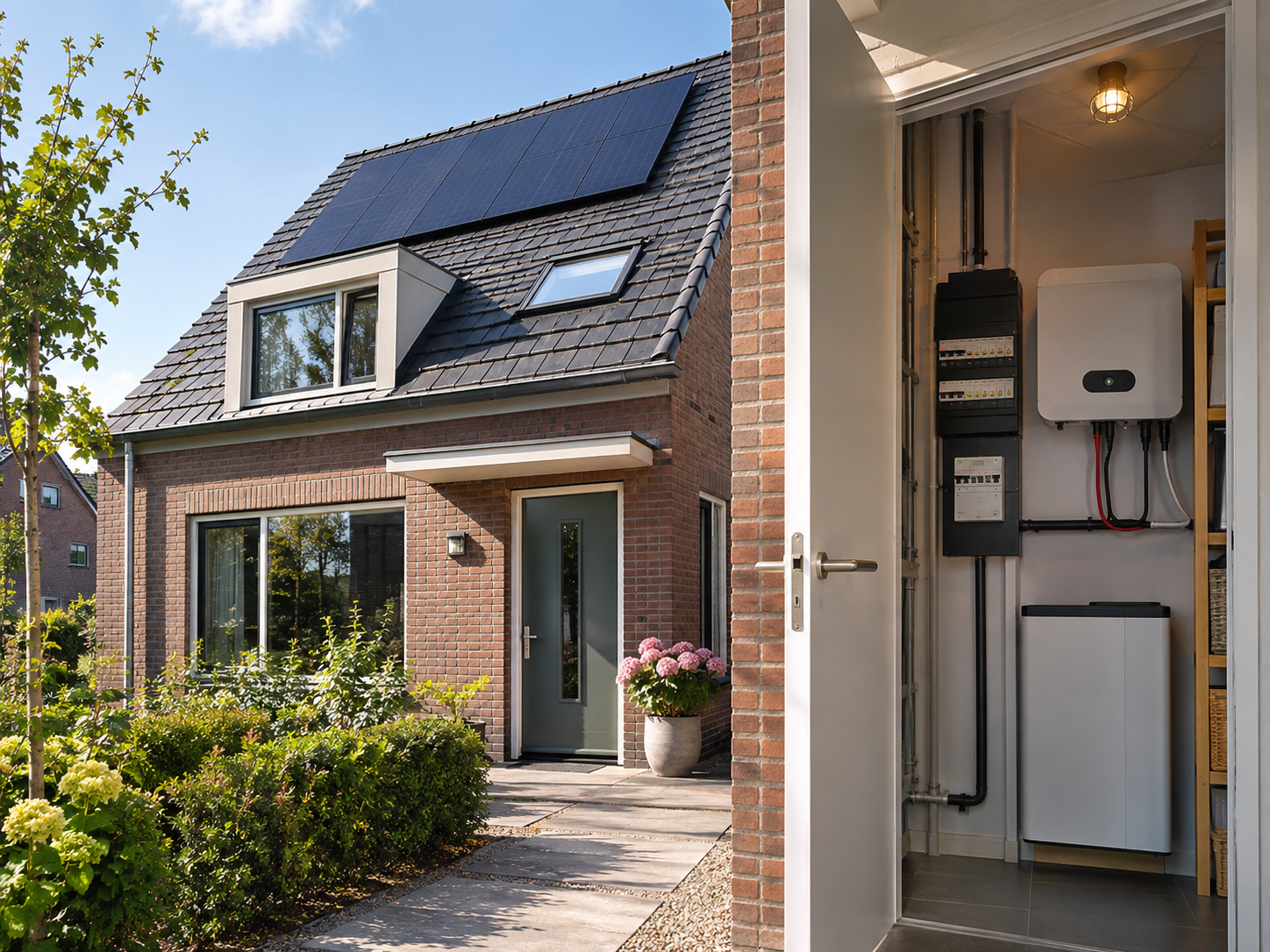
A modern home with solar panels and a technical room with inverter and distribution board.
Why this causes so much confusion
Homeowners with solar panels often see several numbers at once:
- the production shown by the inverter app;
- the household consumption shown by an energy manager or Home Assistant;
- the import and export totals on the smart meter;
- the charges on the energy bill.
All of those numbers can be correct, but they do not describe the same thing. An inverter measures how much solar energy your PV system produces. The smart meter measures what is exchanged through the grid connection: energy imported from the public grid and energy exported back to it.
The difference between single-phase and three-phase
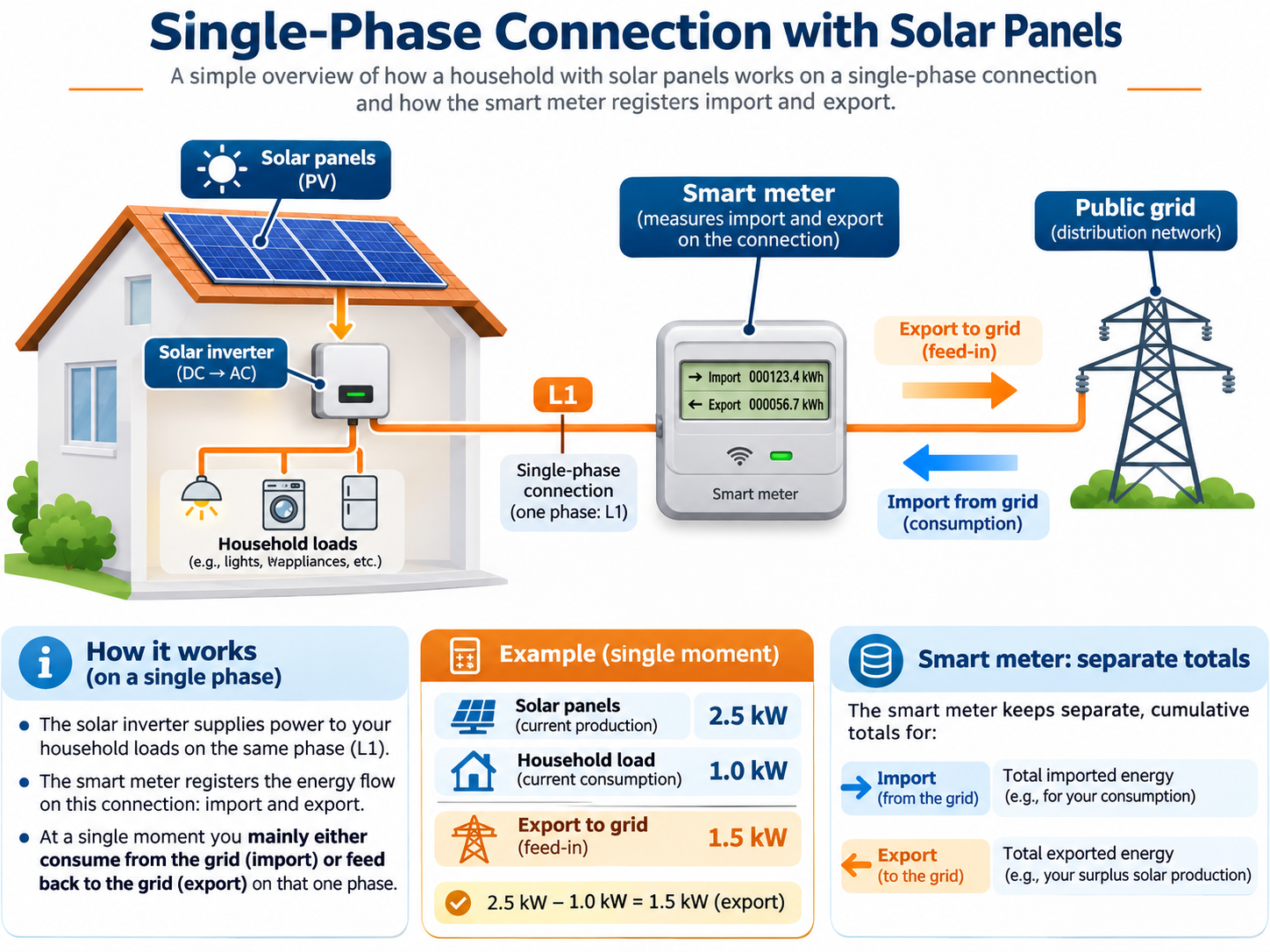
With a single-phase connection, most of the installation runs on one phase (L1) and a neutral conductor. That makes the concept fairly easy to understand: the solar panels, the household loads and the meter all operate on the same track.
With a three-phase connection, there are three phases: L1, L2 and L3. Larger loads such as a heat pump, EV charger or cooking equipment may be spread across those phases. An inverter may also be single-phase or three-phase. As a result, several energy flows can exist at the same time.
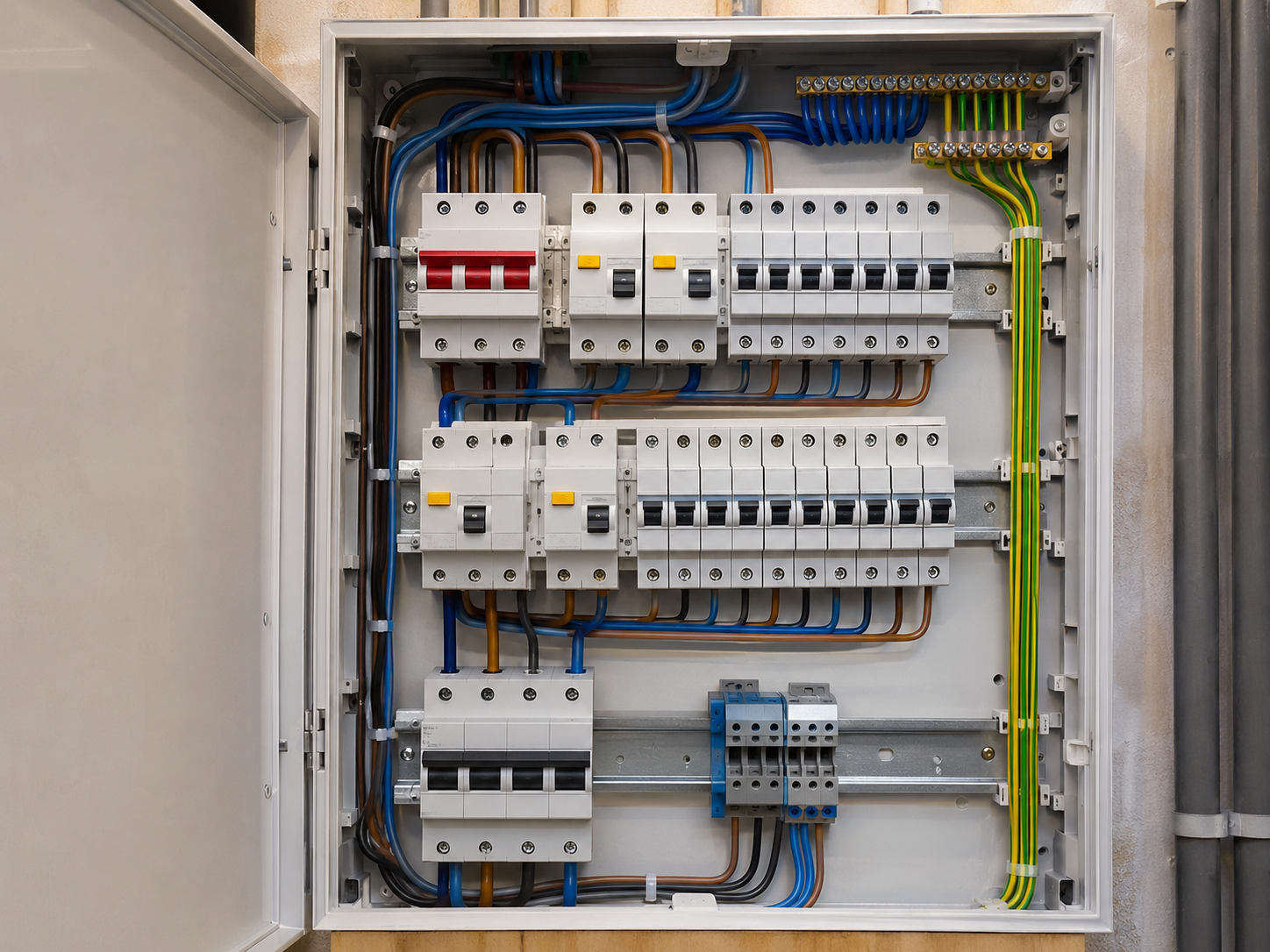
What exactly does the smart meter record?
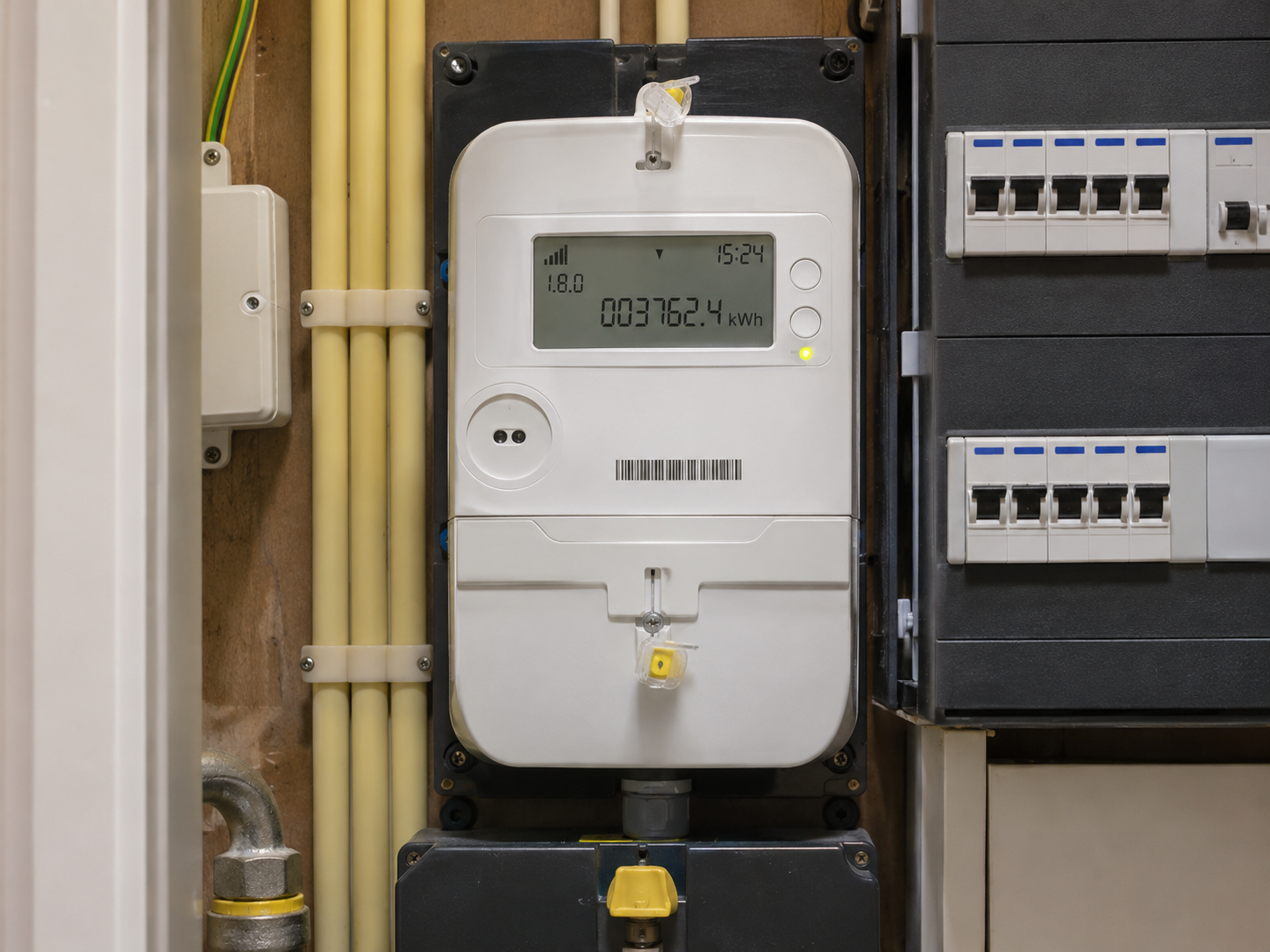
The smart meter keeps at least two crucial totals:
- Import: all energy taken from the grid.
- Export: all energy fed back into the grid.
On many meters, these totals correspond to 1.8.x for import and 2.8.x for export. On a three-phase connection, the meter looks at the net energy flow on the full connection. In other words, it does not look only at L1 or only at L2, but at the total of L1 + L2 + L3 together.
How it works on a single-phase connection
On single-phase, the explanation is straightforward. If the PV system produces more power than the home uses at that moment, the surplus flows via L1 to the grid: export. If the home uses more than the solar panels produce, the difference comes in from the grid via L1: import.
Single-phase example:
- Solar production: 2.5 kW
- Household load: 1.0 kW
- Net export: 1.5 kW
The meter will therefore register export at that moment. Later in the day that can of course reverse, for example when solar production drops and household demand stays high.
How it works on a three-phase connection
Three-phase is where things become more interesting. At a single moment, the smart meter may see power flowing to the grid on one phase while power is drawn from the grid on another phase. For the actual exchange with the grid, the decisive value is the net result across the full connection.
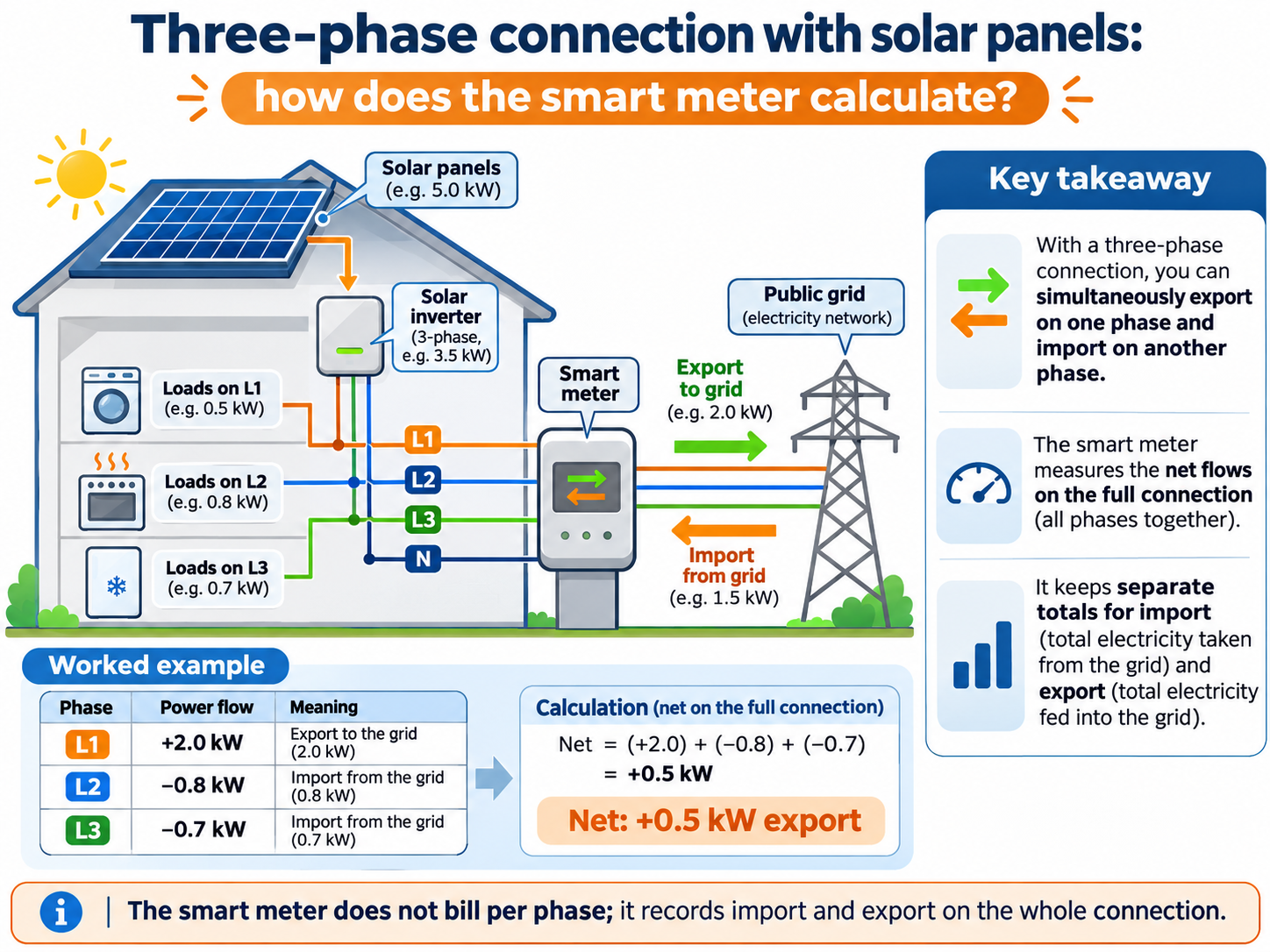
Three-phase example:
- L1: +2.0 kW export
- L2: −0.8 kW import
- L3: −0.7 kW import
The net exchange on the connection is therefore:
+2.0 − 0.8 − 0.7 = +0.5 kW
So the result is 0.5 kW net export at that moment.
Important distinction: instantaneous flow versus long-term totals
A common source of confusion is the difference between a live snapshot and the accumulated totals over time. At a certain moment, the meter may show net export. One hour later it may show net import. Over days, months and eventually the full year, the meter adds up those moments into cumulative import and export totals.
That is why it makes sense to look not only at a live graph, but also at the running totals on the meter.
Why does the inverter app differ from the energy bill?
This difference is normal. The inverter measures only solar production. That includes the solar power you use directly in your own home, without it ever going through the public grid. The smart meter only sees what is imported from or exported to the grid connection.
A simple example:
- Your panels produce 3.0 kW.
- Your home uses 1.2 kW at the same time.
- The inverter app shows 3.0 kW production.
- The smart meter registers 1.8 kW export.
That “missing” 1.2 kW is not lost. It was used directly in the home.

Why phase distribution matters
Grid operators want to keep the low-voltage network as balanced as possible. That is why there is policy for distributing single-phase loads and single-phase generation across L1, L2 and L3. If too many solar installations in one street are connected to the same phase, that phase voltage can rise more quickly. In extreme situations, the inverter may then shut down because of high grid voltage.
So when a single-phase inverter is installed in a home with a three-phase connection, the chosen phase is important. With a three-phase inverter, the generated power is usually distributed over all three phases, which can be beneficial for balance.
Typical situations at home
1. Single-phase home with solar panels
This is the simplest case. The meter sees one phase and records either import or export on that connection.
2. Three-phase home with a single-phase inverter
The inverter often feeds back on one phase. At the same time, other loads on other phases may demand power. That is why an energy manager can show import and export simultaneously on different phases.
3. Three-phase home with a three-phase inverter
Export is usually spread more evenly. Even then, the smart meter still evaluates the overall exchange on the whole connection.
Frequently asked questions
Is settlement done per phase?
No. In practice, the smart meter is relevant because it keeps the cumulative totals for import and export on the grid connection. Your annual settlement is not a separate bill per phase.
Why does Home Assistant show import and export at the same time?
Because Home Assistant or an energy meter often measures per phase. That is technically correct, but the smart meter uses the total picture of the connection.
What matters more: the inverter app or the meter?
The inverter app is useful for production data. For billing and grid exchange, the smart meter is the reference point.
Conclusion
The key message is simple:
- with single-phase, the energy flow is easy to follow and import or export happens on that one phase;
- with three-phase, export and import can happen simultaneously on different phases;
- the smart meter looks at the exchange on the full connection and keeps separate totals for import and export;
- the production shown by your inverter app is therefore not the same as the export shown on your energy bill.
Once you understand this, live energy data, phase distribution and the numbers on your annual statement become much easier to interpret.
Netbeheer Nederland – Smart meter: frequently asked questions
Netbeheer Nederland – Calculation method for installers: phase distribution for solar panels, heat pumps and EV chargers on three-phase connections
ACM ConsuWijzer – The smart meter
ACM ConsuWijzer – Generating energy and feeding it back to the grid
Sources and references
- Netbeheer Nederland – Smart meter: frequently asked questions
- Netbeheer Nederland – Calculation method for installers: phase distribution for solar panels, heat pumps and EV chargers on three-phase connections
- ACM ConsuWijzer – The smart meter
- ACM ConsuWijzer – Generating energy and feeding it back to the grid