
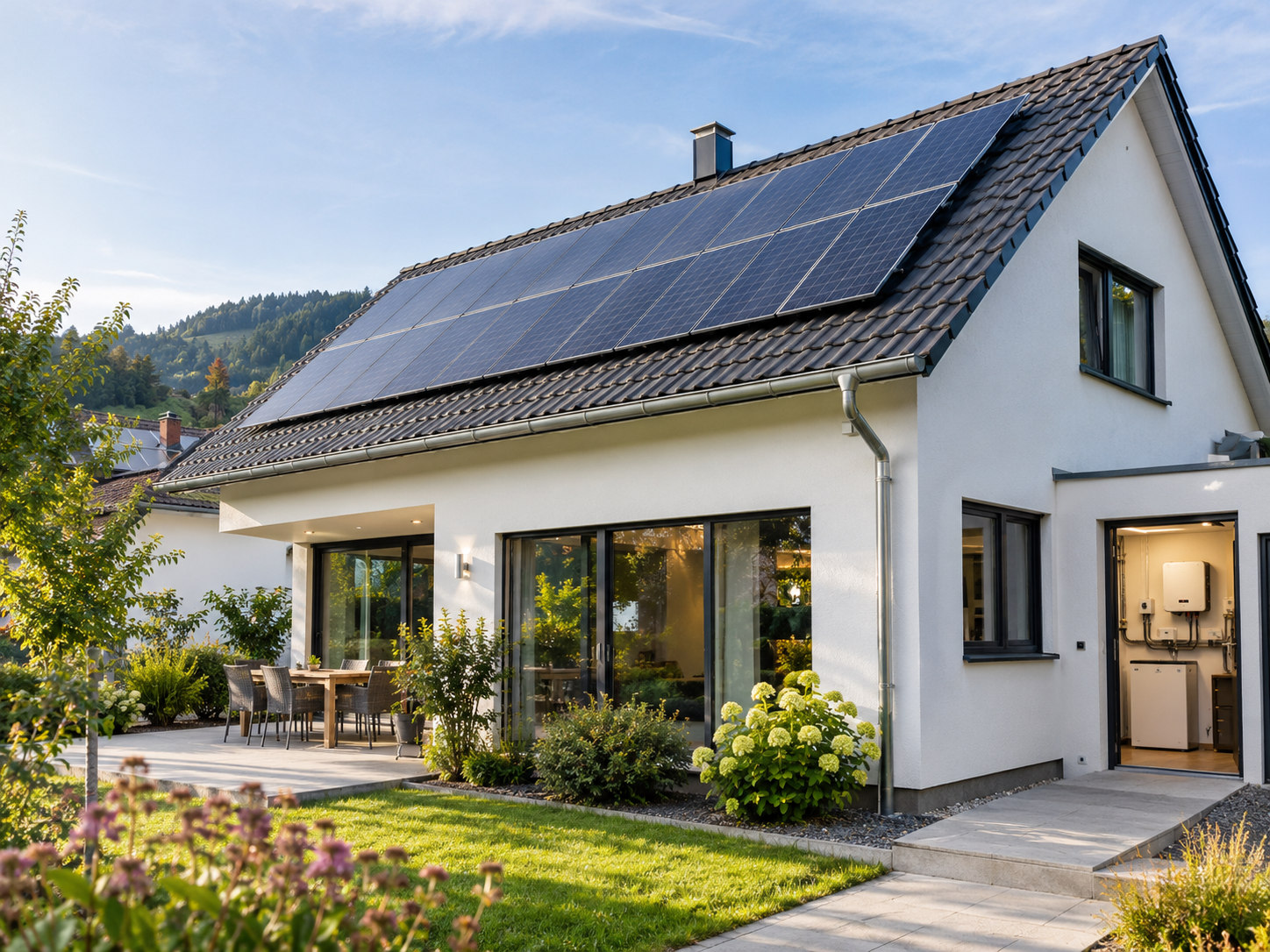
Anyone planning a solar installation eventually runs into the same question: should you choose micro-inverters or a string inverter? Both systems convert the DC electricity from solar panels into usable AC electricity, but they do so in very different ways. One option is not automatically better in every case. From a technical point of view, the best choice depends on roof layout, shade, expandability, monitoring, safety, maintenance and budget.
A modern residential PV system. The inverter architecture affects how the panels work together and how the system behaves under shade, faults and future expansion.
What is a micro-inverter?
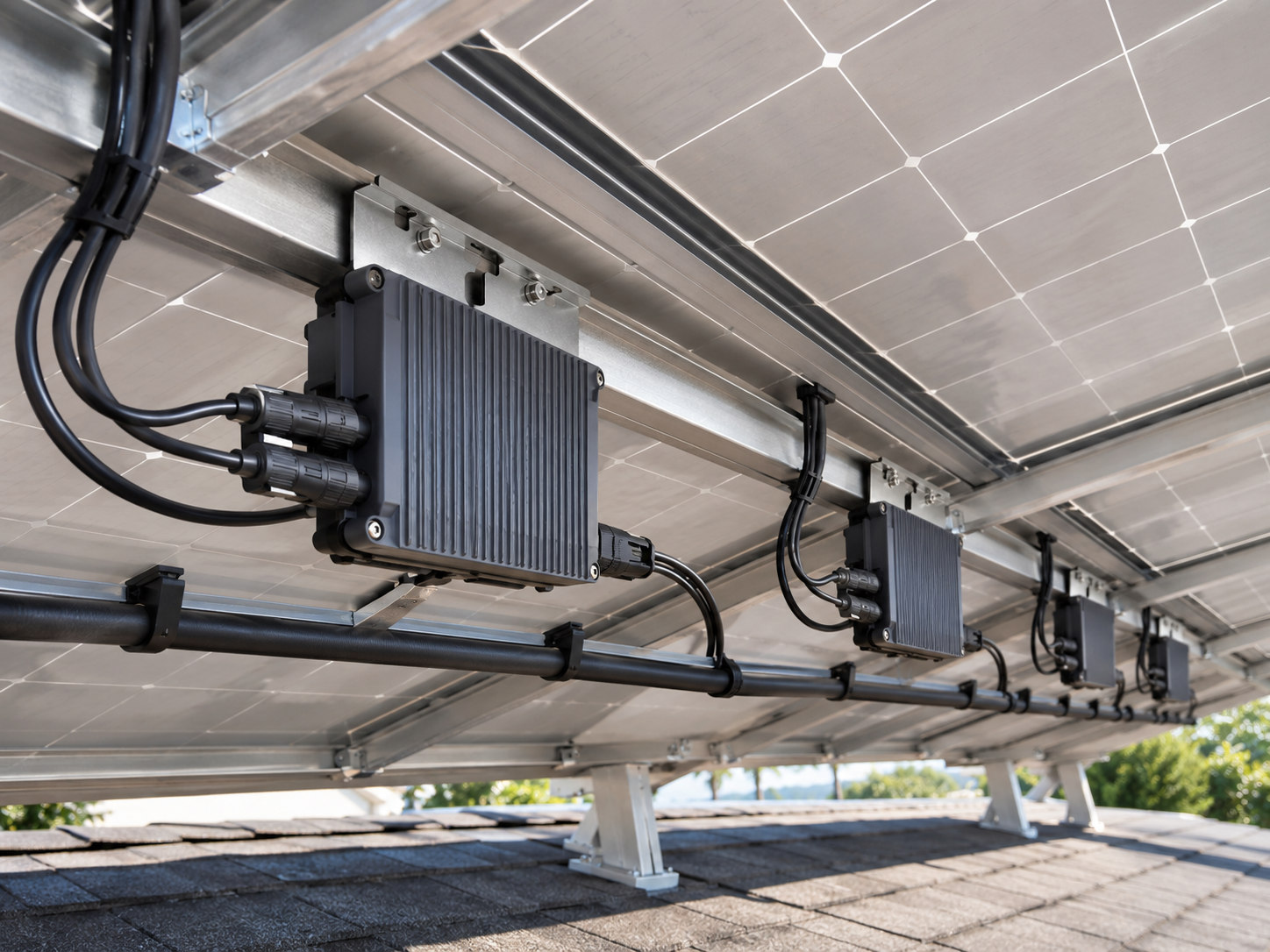
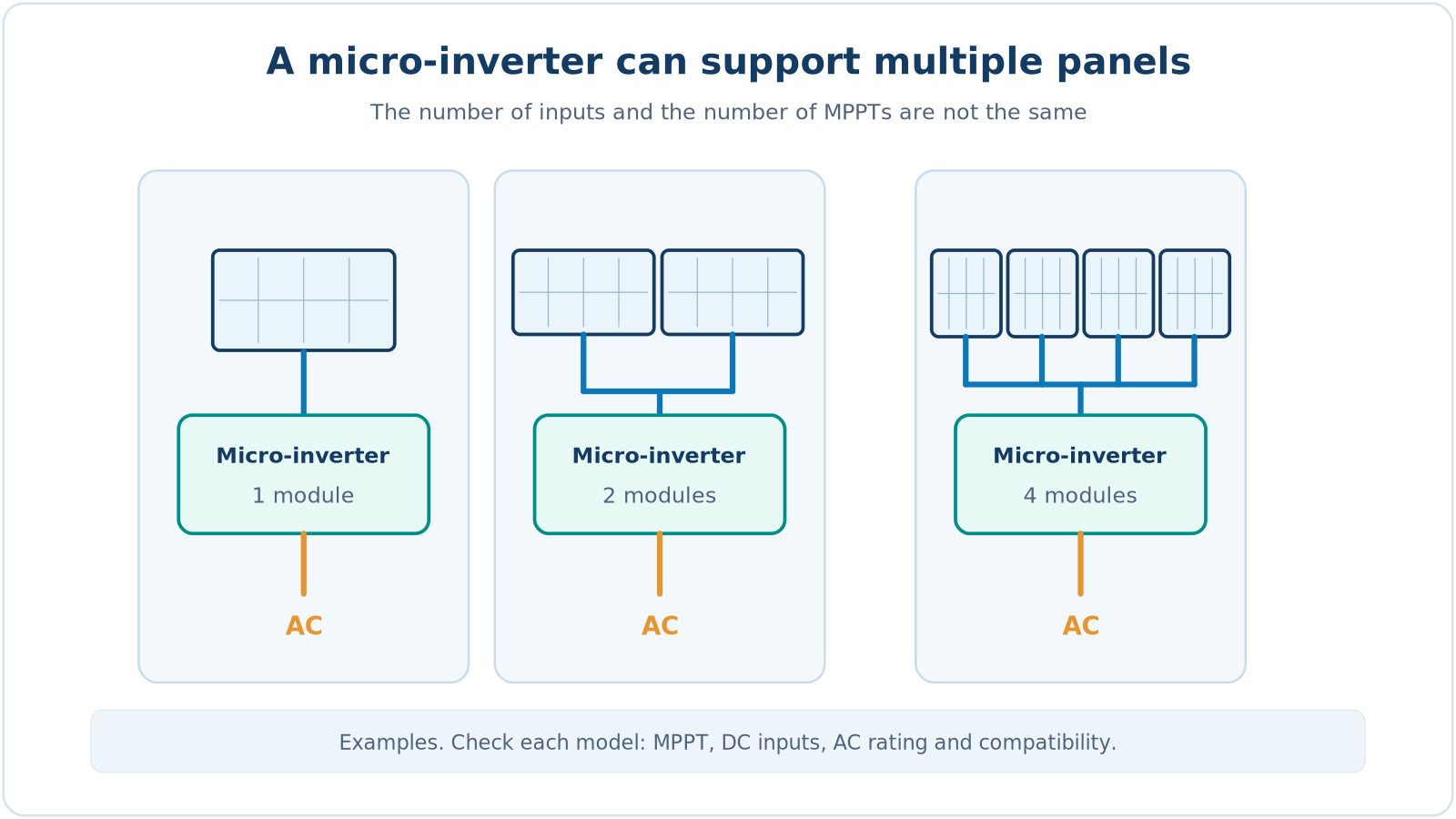
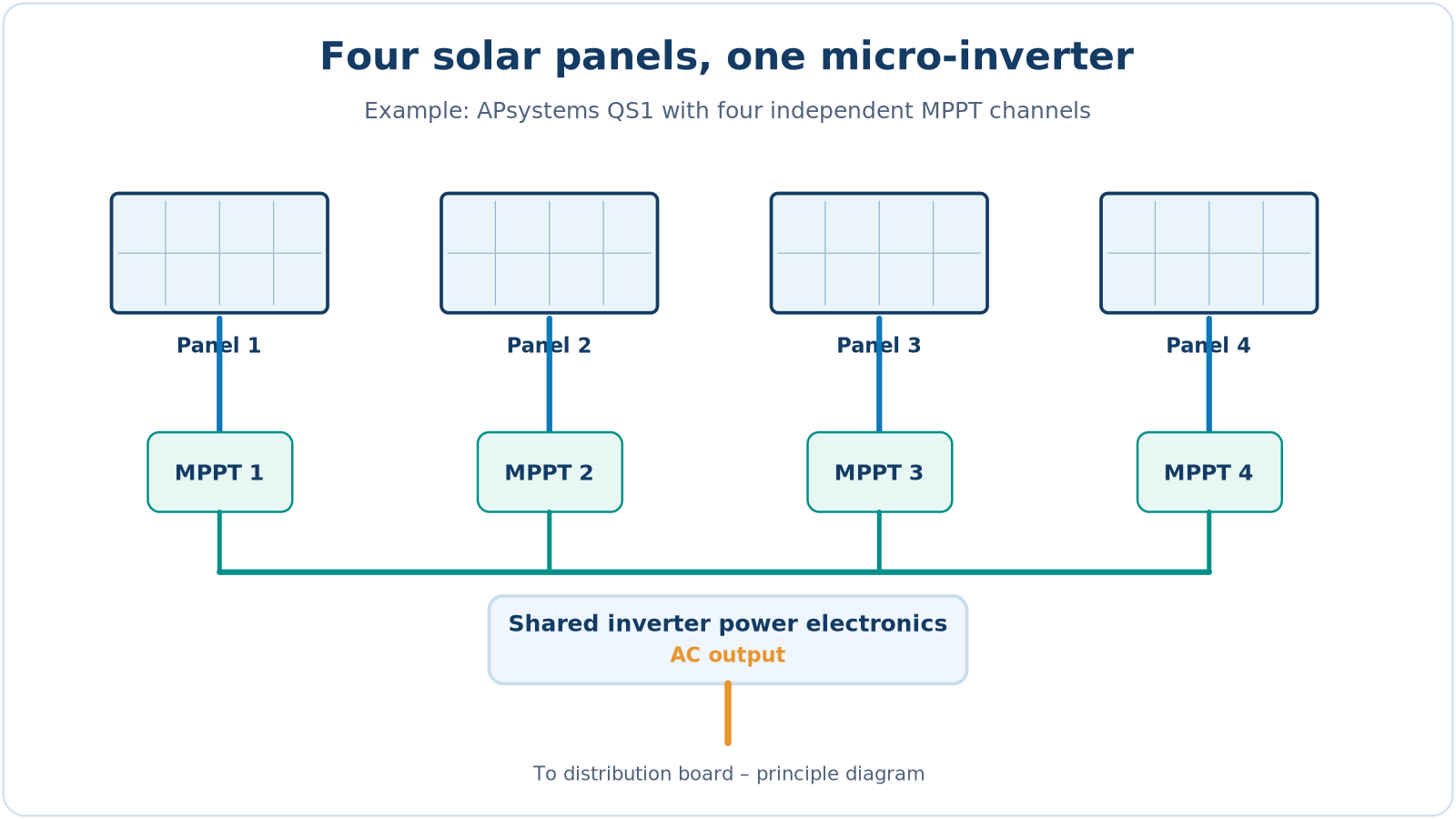
A micro-inverter converts DC electricity from one or more solar modules into AC electricity locally on or near the roof. Depending on the model, one unit can accept one, two, four or even more solar modules. “Micro” therefore does not necessarily mean one inverter per module. For example, a four-module system can use one APsystems QS1 with four separate DC inputs.
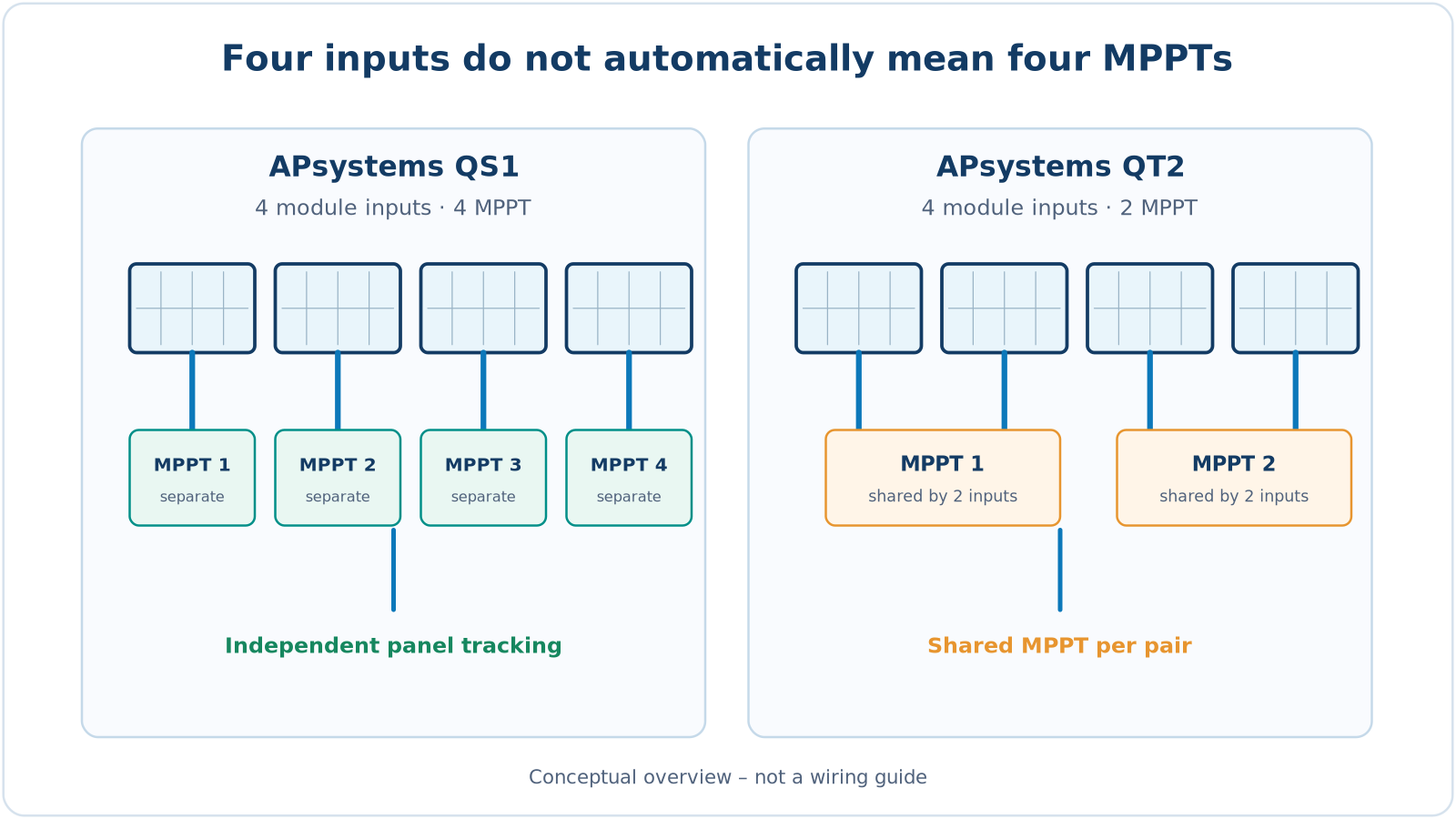
The degree of independence between modules depends on the MPPT architecture. The APsystems QS1 and QS2 have four independent MPPT channels for four modules. The QT2 also accepts four modules, but has two MPPTs, each serving two inputs. A weak module can therefore be tracked separately on one model, while on another model two inputs share a tracker.
How many panels can one micro-inverter support?
The number of connected modules and the number of independent MPPTs should be compared separately. A four-input micro-inverter with four MPPTs behaves differently from a four-input model with two MPPTs. In both cases the four modules share an inverter enclosure and AC output. A failure of those shared electronics can therefore affect every connected module.
| Model | Module inputs | Independent MPPTs |
|---|---|---|
| APsystems QS1 | 4 | 4 |
| APsystems QT2 | 4 | 2 |
| APsystems QS2 | 4 | 4 |
What is a string inverter?
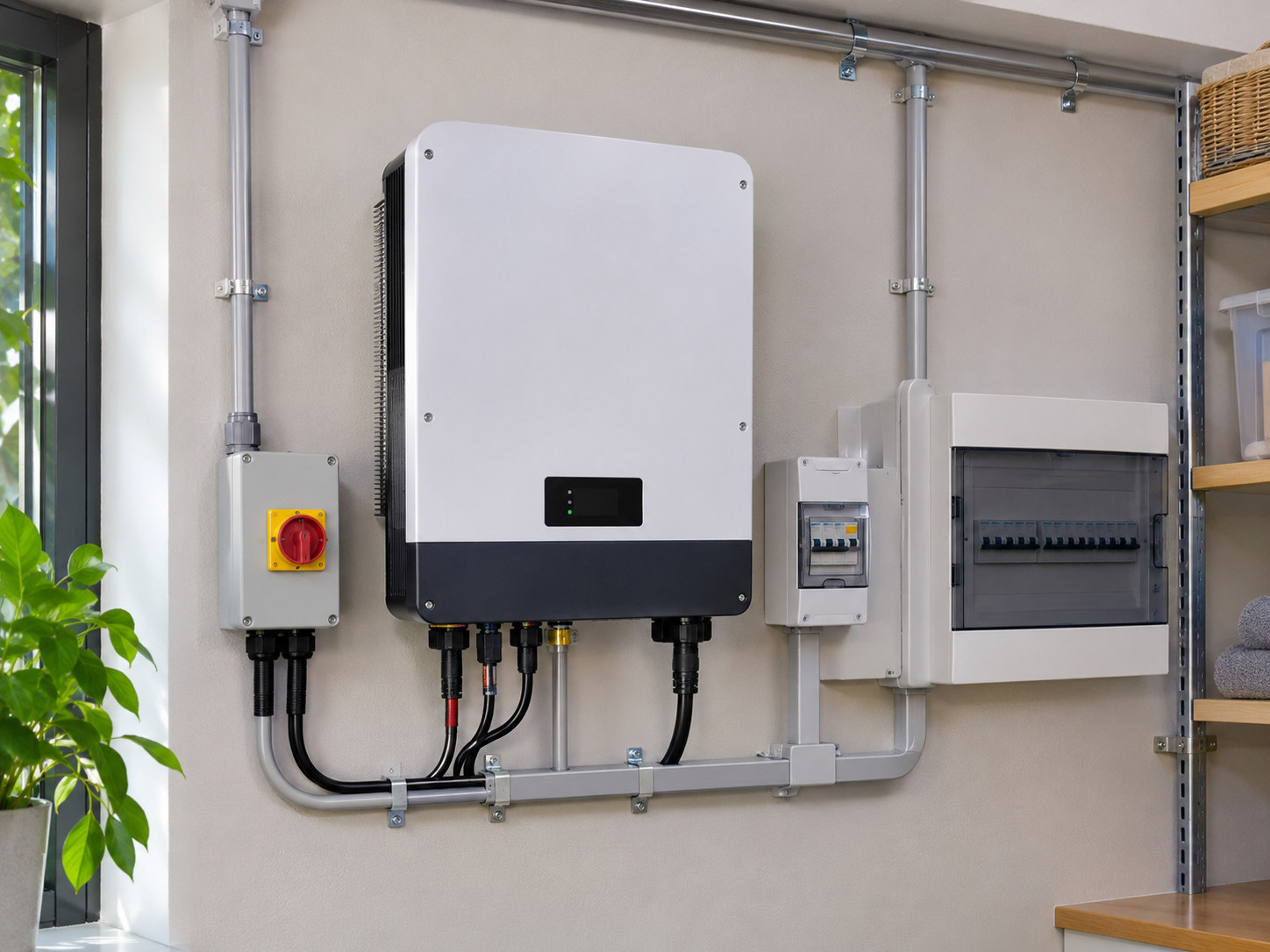
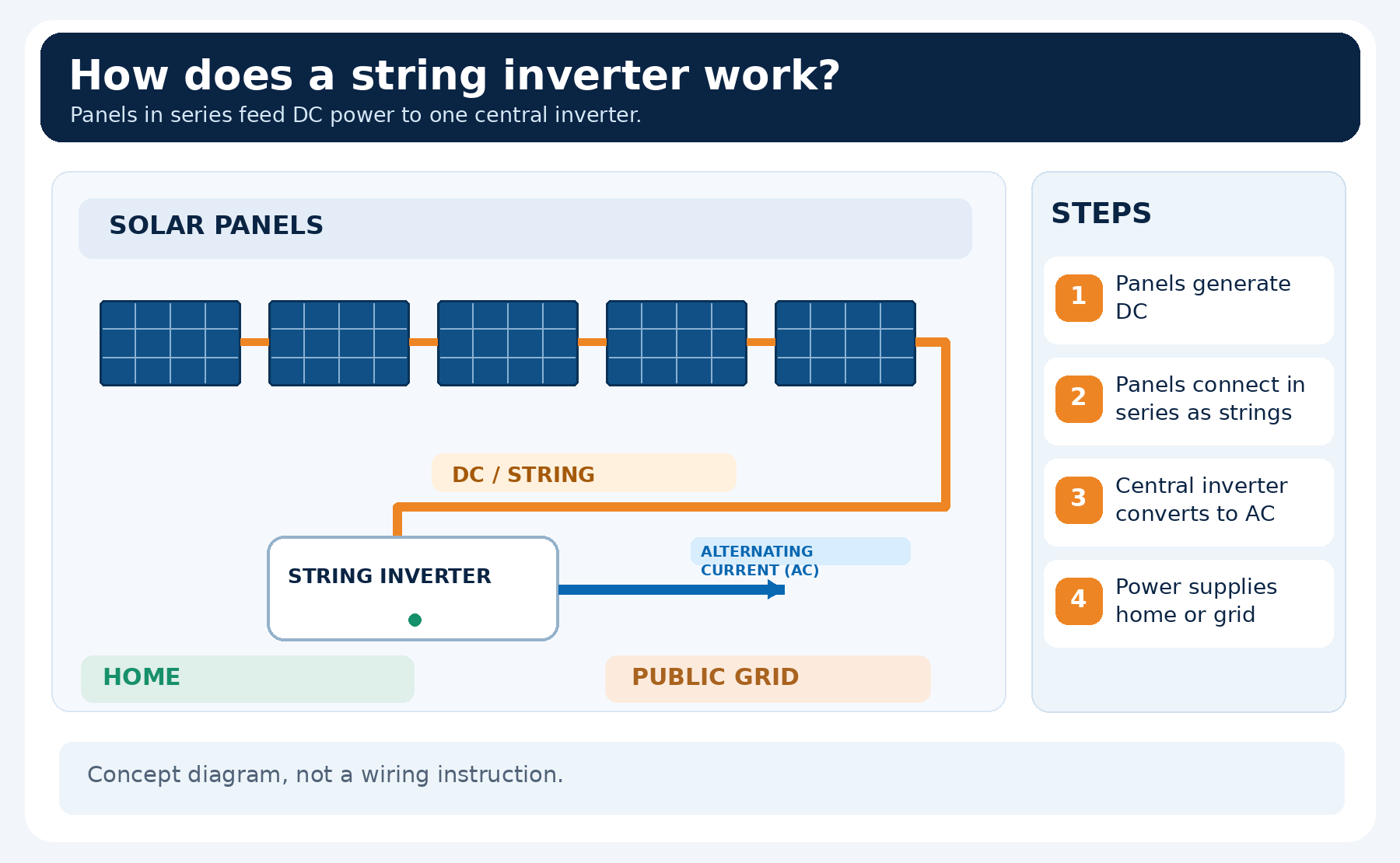
In a string inverter system, multiple solar panels are wired in series into one or more strings. The DC power from each string is routed by DC cabling to one central inverter, usually installed in a utility room, garage or technical room. That central inverter then converts the complete string output to AC power.
This has been the most common and often the most cost-effective solution for years. The system is clean, efficient and technically strong when the panels share similar orientation and there is little shade.
The basic comparison at a glance
| Topic | Micro-inverters | String inverter |
|---|---|---|
| Conversion | Local conversion for one or several modules, depending on model; 1, 2, 4 or more DC inputs are possible | Central conversion per string or set of strings |
| Shade | Strong on partially shaded or complex roofs | Strong on matching panels with low shade |
| Monitoring | Often available per panel | Often available per string or system |
| Expansion | Usually easy to expand | Needs more planning around inputs, MPPTs and inverter sizing |
| Cost | Higher cost per panel | Often lower total system cost |
| Fault behaviour | A failed micro-inverter can affect every module connected to that unit (e.g. four on a QS1 or QT2) | A central inverter fault often affects the full installation |
Technical differences that really matter
1. Shade and complex roof layouts
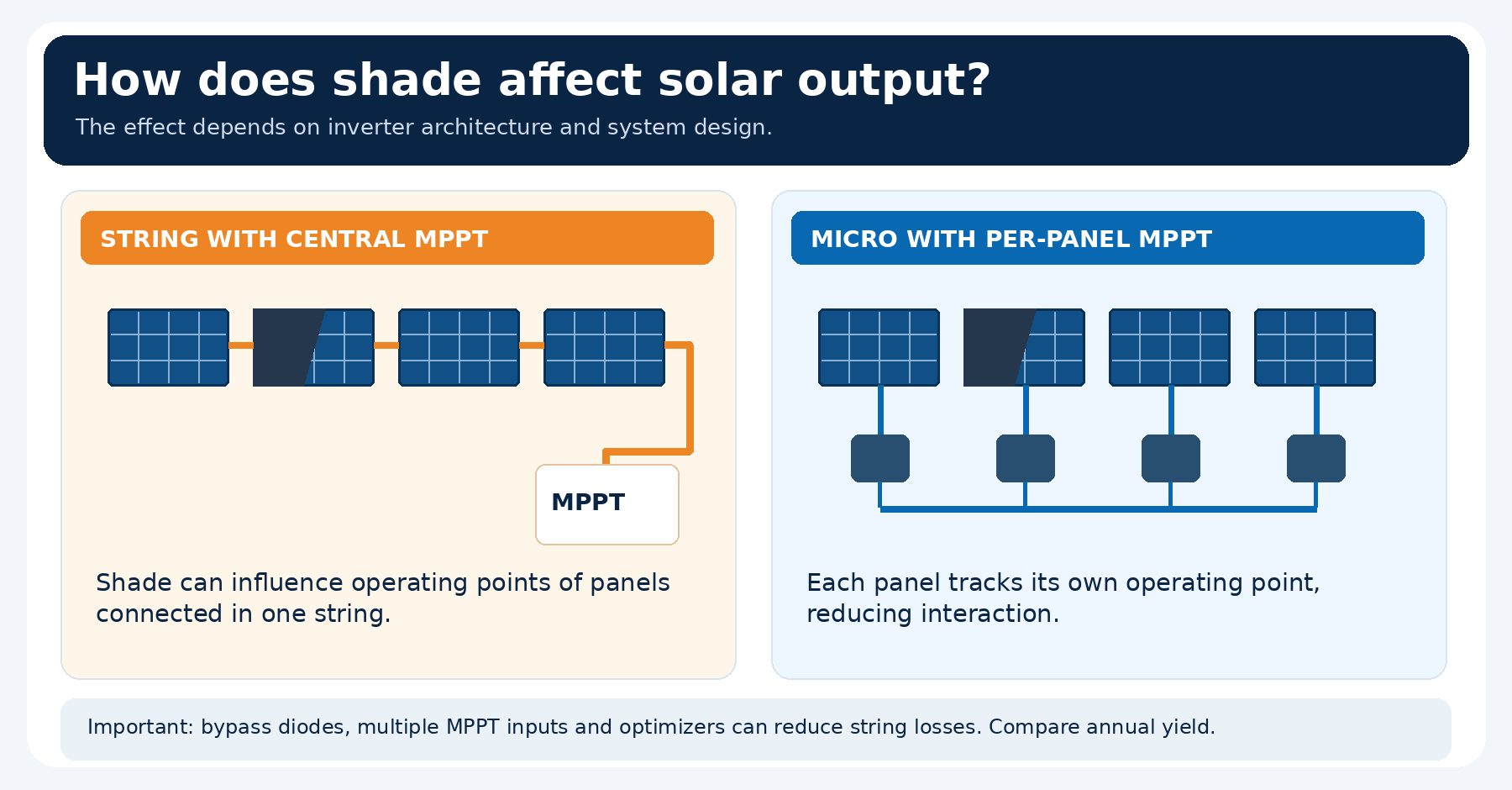
Micro-inverters can be advantageous on roofs with multiple orientations or partial shade. The benefit depends on how many independent MPPTs the inverter provides. A four-input model does not necessarily have four MPPTs. String inverters with multiple MPPTs, bypass diodes and optional optimizers can also handle mismatched conditions well.
A string inverter is very strong when the panels are similar and the whole roof area behaves in a consistent way. In that case, system losses are low and the simplicity becomes a major advantage.
2. Safety and DC voltage
A major technical difference is the presence of higher DC voltages on the roof in string systems. With micro-inverters, the conversion to AC takes place right at the panel, so the DC paths remain short and local. That is often seen as a safety advantage, especially in discussions around maintenance, fault finding and fire scenarios.
That does not mean string inverters are unsafe. A properly designed string system fully complies with applicable standards and uses suitable protection measures. Still, the architecture is different, and so is the distribution of components and risks.
3. Monitoring and diagnostics
Many micro-inverters provide panel-level monitoring. This depends on the hardware, monitoring platform and individual input channels; it does not automatically follow from the word micro-inverter. Some string systems can also provide module-level data when used with optimizers.
4. Yield and efficiency
Both architectures can achieve high efficiency. Annual yield depends on roof layout, shading, MPPT grouping, sizing, wiring and conversion losses. Module-level tracking can help on complex roofs, but a multi-input micro-inverter with shared MPPTs does not always provide the same independence as one with an MPPT for every module.
So the right question is not only: which device has the highest peak efficiency? The better question is: which architecture gives the highest useful annual yield on my roof?
5. Maintenance and fault behaviour
Micro-inverter systems use multiple inverter enclosures on or near the roof. A failure generally does not stop the entire installation, but it can stop all modules connected to the affected micro-inverter. On a four-module unit that means four modules may stop producing. Replacement also frequently requires rooftop access.
A string inverter is more centralized. That can simplify service because the main power electronics are in one accessible location. The trade-off is that a failure of the central inverter can disable a much larger part of the system, or even the full installation.
How does a string inverter work?
How do micro-inverters work?
When are micro-inverters technically the better choice?
- On roofs with multiple orientations or different roof planes.
- Where partial shading is common.
- When panel-level monitoring is important.
- When future expansion in small steps is likely.
- When the goal is to limit failures to the modules connected to the affected micro-inverter.
When is a string inverter technically the better choice?
- On one or a few large, uniform roof planes with little meaningful shade.
- When lower system cost is important.
- When a simple, centralized design is preferred.
- When the full system size is known from the start and future changes are unlikely.
- When easy access to the main service component is valuable.
So which one is technically better?
The honest answer is: there is no universal winner. In this topic, “technically better” really means “better suited to the actual situation”.
Micro-inverters are often technically stronger on complex roofs, under shade and where panel-level monitoring is desirable.
String inverters are often technically stronger on simple, uniform roofs where low cost, simplicity and centralized service are key priorities.
For a standard residential roof with one large roof plane and little shade, a string inverter is often the most logical technical and economic solution. For homes with multiple orientations, smaller roof areas or frequent shading, micro-inverters can be clearly more attractive from a technical perspective.
Practical conclusion for MechScript readers
When selecting a system, do not look only at the price per watt-peak. Also ask about:
- the shade and roof analysis;
- the chosen system architecture;
- the monitoring level;
- future expandability;
- fault behaviour and service strategy.
Only when those points are clear can you honestly determine which system is technically better for your home.
APsystems QS1 ·
APsystems QS2 ·
APsystems QT2 ·
APsystems Installer FAQ