
Is storing energy as hot water a smarter idea than storing electricity? A sober comparison for households with solar panels.
MechScript | Energy & building services | October 2026
The short version. If you already have an electric boiler, it can be very attractive to heat it mainly when your solar panels are producing electricity. You shift the same consumption to a cheaper time. This can require relatively little additional equipment. But buying a complete electric boiler specifically to “store” solar electricity is a different proposition. Especially if you currently make hot water with a heat pump, it may be an unfavourable choice.
This article is not about miracle solutions. It shows what a hot-water tank can actually store, what savings are realistic and what to consider in its installation and control.
1. Why put electricity into hot water?
On a sunny afternoon, a home may export a substantial amount of electricity. The washing machine has finished, nobody is cooking and the electric car is not in the driveway. The inverter is producing, but the house needs little electricity at that moment.
Up to and including 2026, a household with a small connection may, within the rules of the Dutch net-metering scheme, offset exported electricity against later imports. That statutory scheme ends on 1 January 2027. From then on, imports and exports will be settled separately. The payment for exports and the eventual export charges depend on the contract. [1][2]
That makes the timing of electricity use more important. An appliance running during daytime solar production avoids buying electricity at another tariff. This may sound like a matter of a few cents, but over a year it can add up considerably.
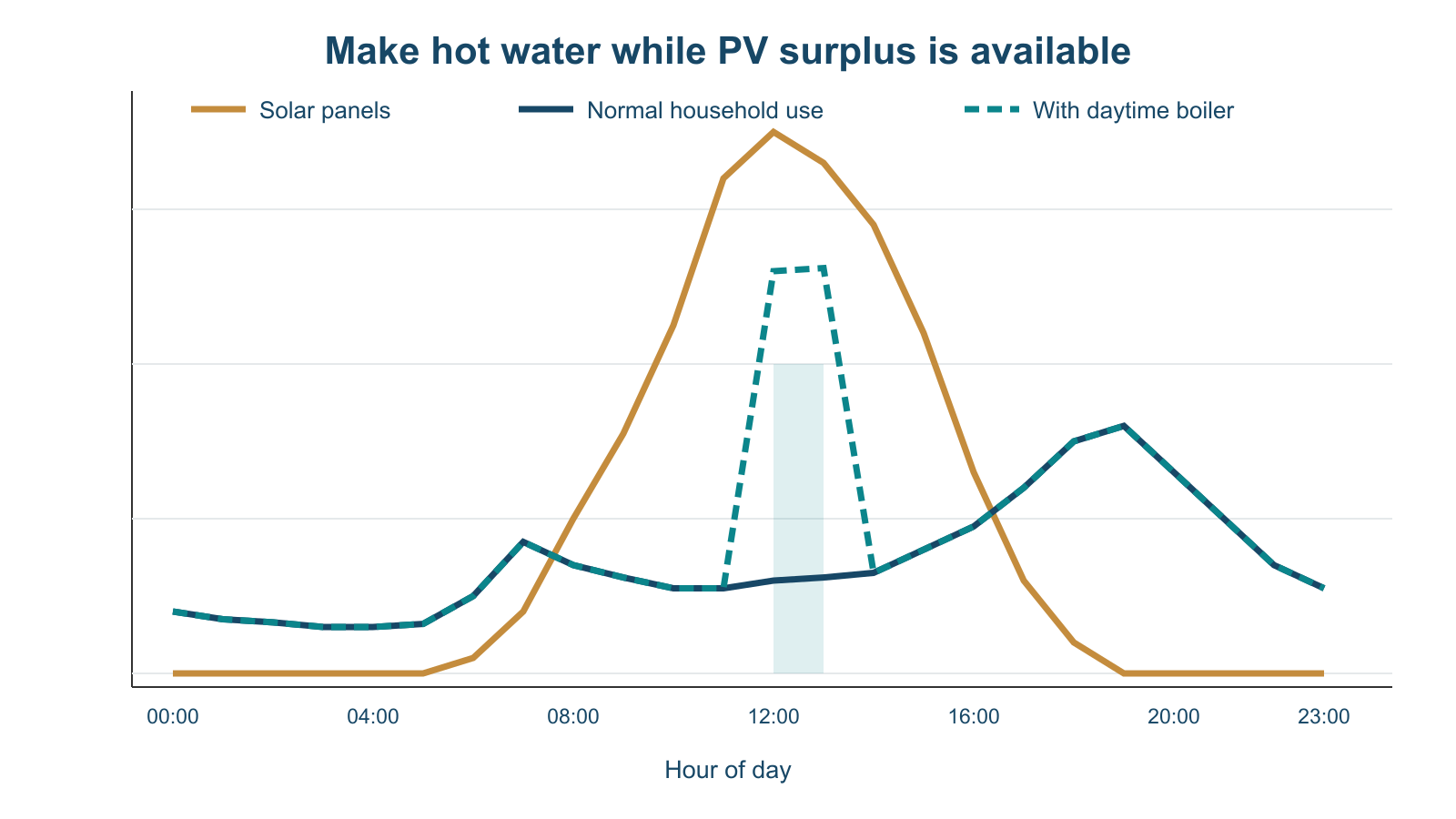
A boiler is interesting here because the moment of heating does not have to coincide exactly with the moment of showering. Its insulated tank bridges those hours. For example, you heat water at 13:00 and use it at 20:00.
The principle: a boiler can shift your electricity use in time. It does not generate extra energy or make an electric resistance element more efficient.
2. How does an electric boiler work?
A conventional electric storage boiler contains an insulated tank, a heating element, a thermostat and protections against overheating and unsafe pressure. The element converts almost all electrical energy into heat. Hot water stays in the tank until you draw it; new cold water flows in.
A boiler with a 2,000-watt element uses about 2 kW of electrical power while heating. If it heats for two hours, it needs about 4 kWh of electricity. The actual time depends on capacity, starting and final temperature, and heat losses.
There is a fundamental difference from a home battery. The battery can later supply stored electricity to a refrigerator, computer or induction hob. The boiler supplies only domestic hot water. It is therefore a limited form of energy storage for one specific purpose.
3. How much energy is really in a tank of water?
The physics is straightforward. For water, approximately:
Energy (kWh) = litres × temperature difference (°C) × 0.001163
This is the theoretical amount of heat added. Losses, mixing and capacity that cannot be fully used are not yet included.
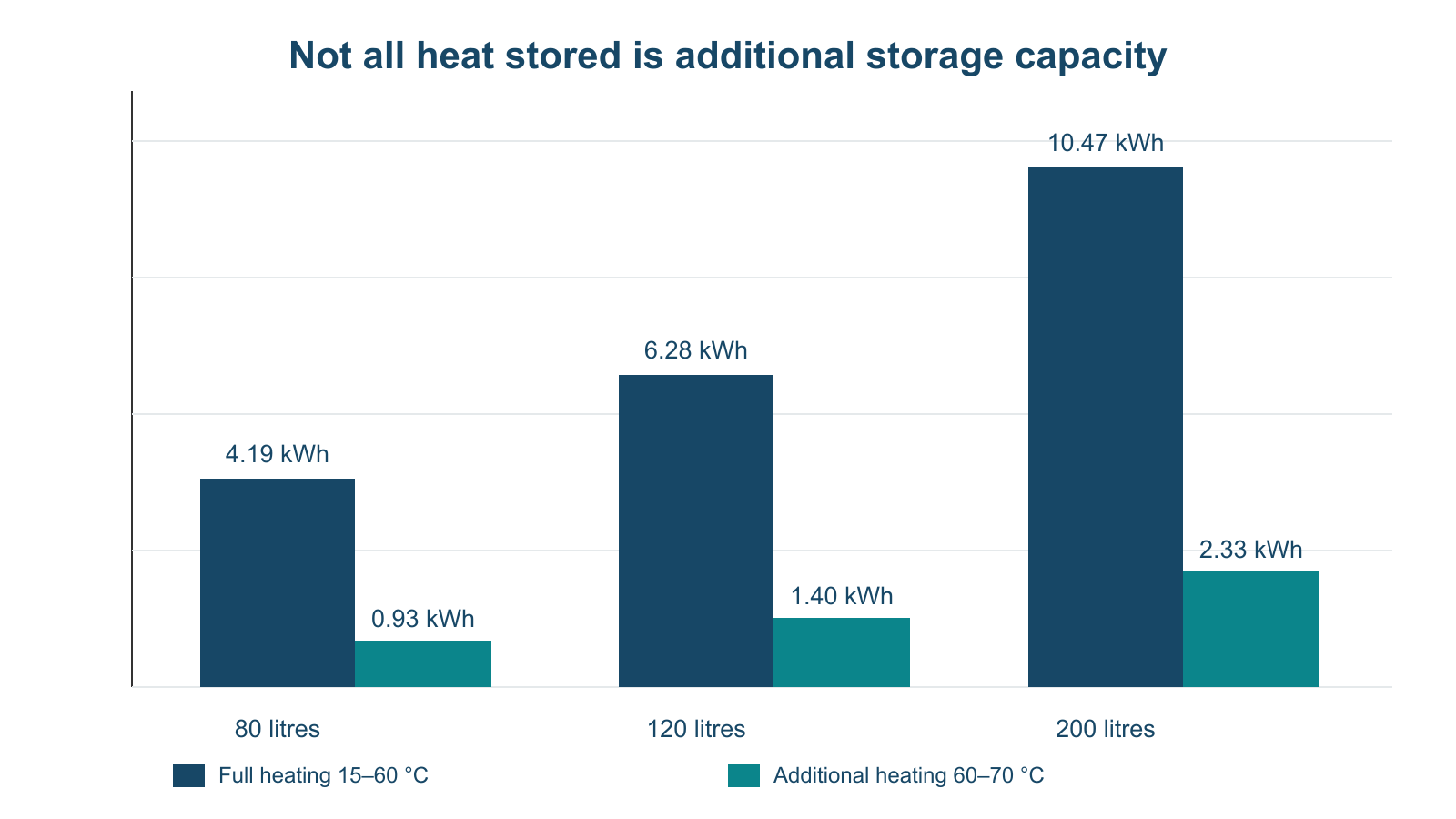
A 120-litre tank heated from 15 to 60 °C needs about 6.28 kWh of heat. That figure expresses how much heat is needed to bring cold water to that temperature; it does not express how much extra flexibility you have in an already hot boiler.
That distinction is easily missed in advertisements and online discussions. If the tank is already at 60 °C and you want to store additional solar energy, the extra storage from heating it from 60 to 70 °C is only 1.40 kWh. Raising it from 60 to 75 °C adds about 2.09 kWh. Whether those temperatures are permitted and useful depends on the appliance, water safety and comfort controls.
Theoretical examples
| Boiler capacity | 15 → 60 °C, full heating | 60 → 70 °C, additional storage |
|---|---|---|
| 80 litres | 4.19 kWh | 0.93 kWh |
| 120 litres | 6.28 kWh | 1.40 kWh |
| 200 litres | 10.47 kWh | 2.33 kWh |
Practical storage potential also depends on how much hot water you actually use later. If you draw hardly any hot water, you gain little from an extra-hot tank that loses heat in the meantime.
4. First decide: an existing boiler or a new one?
These are two entirely different situations.
Situation A: you already have an electric boiler. The hot water must be made anyway. Shifting the same heating work from the evening to the afternoon moves electricity use to a more favourable time. A simple timer or smart control may be enough. You do not buy another hot-water appliance and do not necessarily make extra hot water.
Situation B: you want to buy a boiler specifically for your solar panels. Now you must account for the additional purchase, insulation losses, space, installation and any displacement of a more efficient heat source. Much of the cost comes from the new appliance itself. The business case is substantially harder.
Milieu Centraal confirms that smart control of an existing electric boiler is possible, but says the effect of an additional solar-electricity boiler is limited and stresses that a heat pump (boiler) uses electricity much more efficiently. [3]
5. How do you calculate the savings fairly?
Take a household with an existing electric boiler. Energy use for hot water stays the same; only the heating time changes. For this example, assume:
| Assumption | Amount / quantity |
|---|---|
| Electricity bought from the grid, including taxes | €0.30/kWh |
| Net foregone revenue when not exporting | €0.08/kWh |
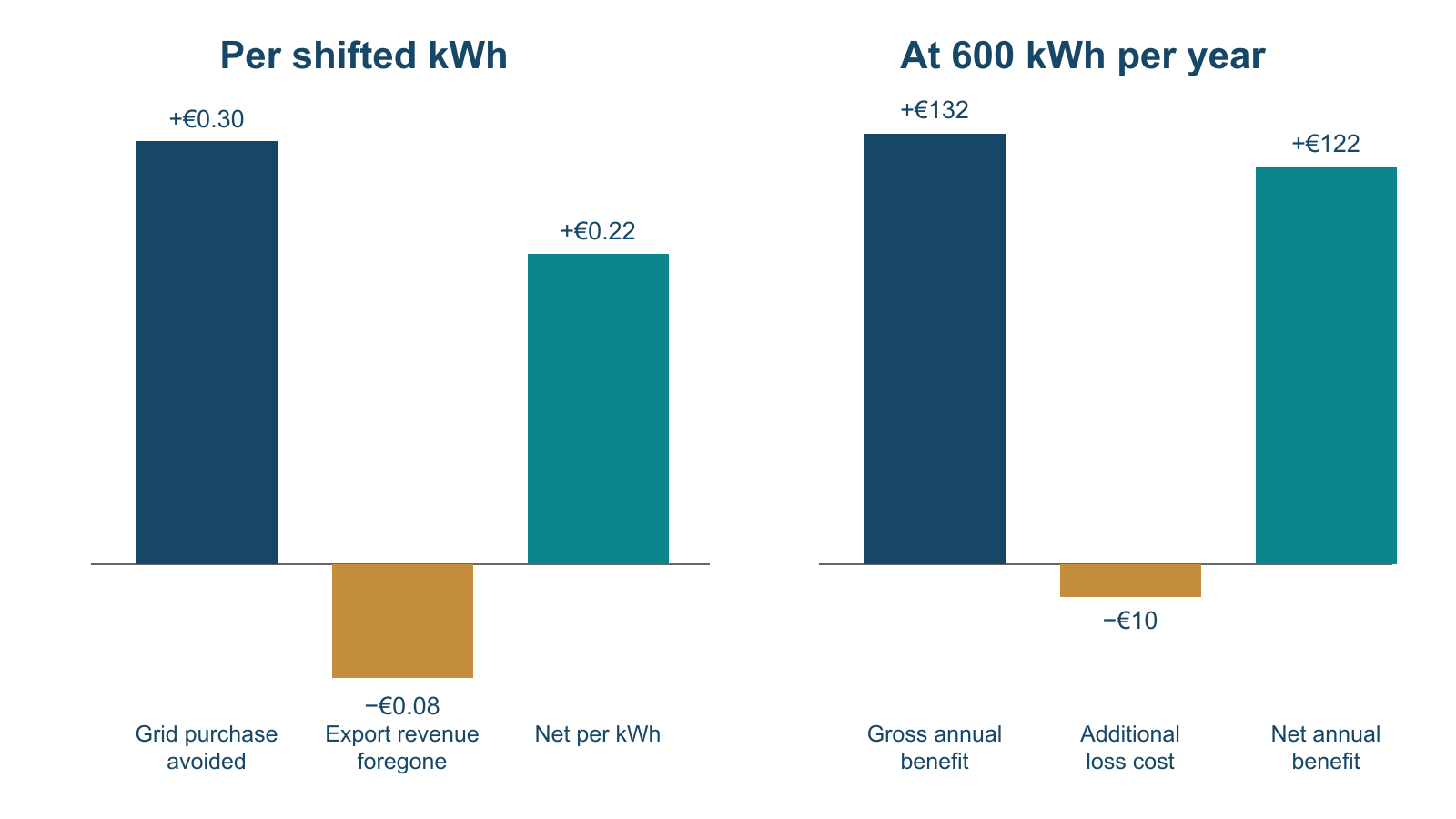
| Solar electricity shifted through the boiler each year | 600 kWh |
| Additional annual loss cost due to scheduling | €10 |
| Cost of a simple, suitable controller | €250 |
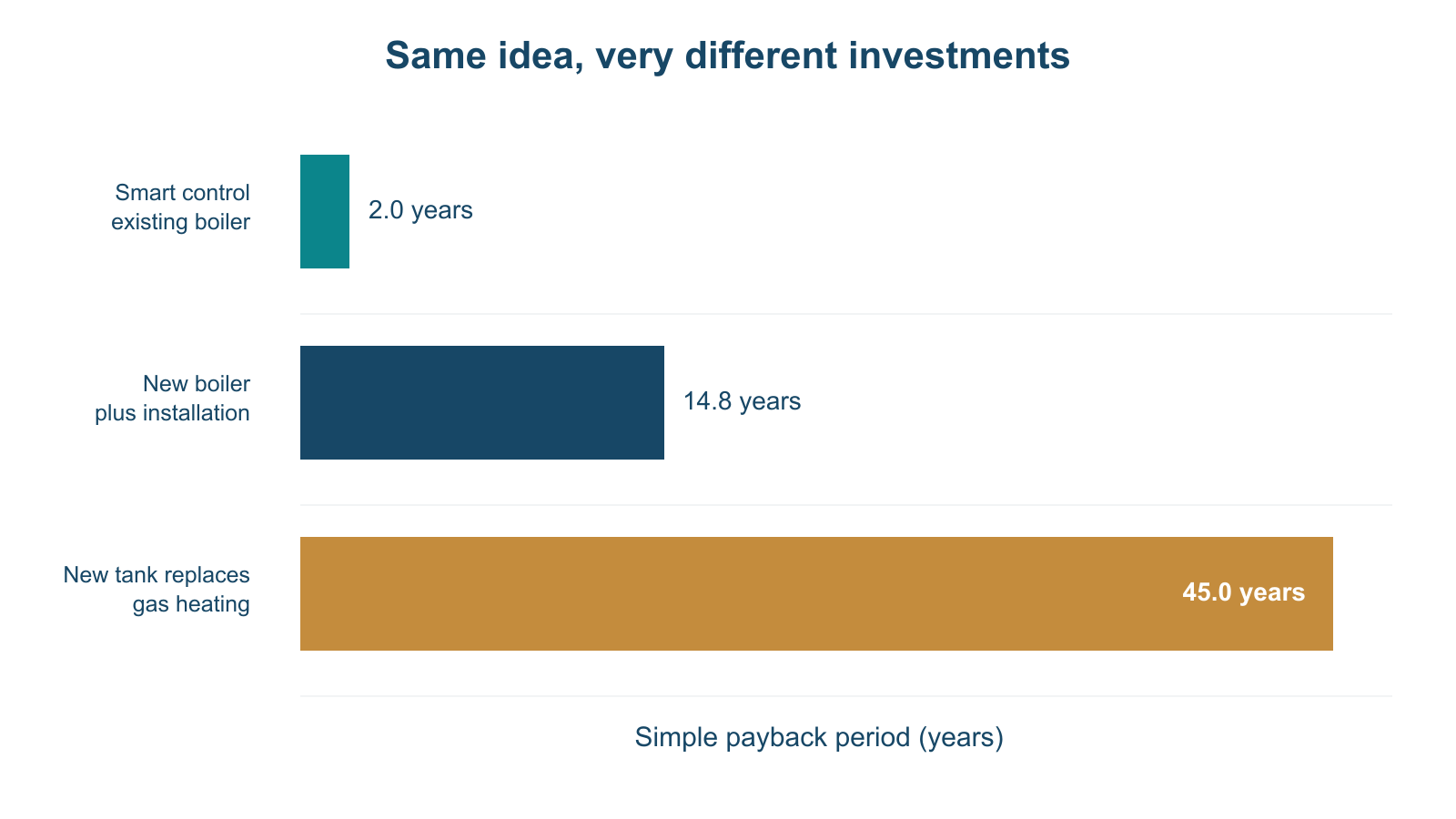
Each shifted kWh has a gross benefit of €0.30 − €0.08 = €0.22 in this example. At 600 kWh, that is €132 a year. After €10 in additional loss cost, €122 a year remains. The simple payback period for the controller is then about 2.0 years.
This is not a promise for any particular household. The amount you can actually shift depends on hot-water use, standby losses, solar production and the limits of the temperature control. The benefit could be much lower in another home.
Export charges complicate the calculation
An energy supplier may apply an export payment and separate export charges. When deciding whether to export or use a kWh yourself, what matters is the marginal net revenue from that kWh. Some contracts state charges per exported kWh clearly; others use tiers. So do not simply use the figure labelled “export payment” on the annual bill. [2]
6. Buying a brand-new boiler: a different calculation
Suppose you save the same €122 a year but first have to invest €1,800 in a completely new appliance and its installation. The simple payback period is then about 14.8 years, before maintenance, interest or possible replacement. And the €122 is achievable only if the new boiler genuinely shifts existing energy consumption and does not cause additional hot-water use.
An additional boiler alongside a gas boiler or heat pump does not automatically fit the same favourable calculation. First establish which energy costs the boiler actually displaces. Otherwise you are comparing unlike things.
7. Electric boiler versus gas boiler
If you currently heat water with a gas boiler, you are not simply shifting electricity imports. You use additional electricity and save gas. The value of one kWh of heat then depends on the gas tariff and the gas boiler’s efficiency.
Fictional example: gas costs €1.30 per m³; for this calculation, one m³ provides about 9.8 kWh of fuel energy, 90% of which usefully reaches the hot water. One kWh of useful heat then costs about €0.147. If you use one kWh of solar electricity for an electric boiler, you avoid about €0.147 of gas cost but forego €0.08 of export revenue. That leaves about €0.067 of benefit before heat losses and the cost of additional equipment.
At 600 kWh of useful heat a year, that is only about €40 of benefit a year. Recovering the cost of a new boiler costing hundreds or thousands of euros solely from this benefit is very difficult. The figures are illustrative; boiler efficiency, hot-water demand and fixed gas charges can also change the balance.
8. Electric boiler versus heat-pump water heater
In an electric resistance boiler, about 1 kWh of electricity becomes 1 kWh of heat. A heat-pump water heater extracts heat from air and uses electricity to do so. Under suitable conditions, it can therefore deliver several kWh of heat from 1 kWh of electricity.
Consider a simplified example of a heat-pump water heater with an average COP of 3. It needs about 1 kWh of electricity to provide 3 kWh of useful heat. A resistance boiler needs about 3 kWh for the same heat.
If you replace or bypass an existing heat-pump water heater by using an additional electric element during the day, you may lose a major efficiency advantage. That applies even when the electricity comes from solar panels. Surplus solar electricity is not free: using it means giving up an export payment.
With our fictional tariffs, an additional kWh of solar electricity in a resistance element produces 1 kWh of heat. A heat pump with COP 3 could have delivered that same heat using about 0.33 kWh of grid electricity, worth €0.10. After subtracting the €0.08 of foregone export revenue, only €0.02 remains before additional heat losses. Under those conditions, extra electric heating is not very attractive.
9. A higher temperature is not necessarily needed
The simplest strategy is usually not to make the tank as hot as possible. It is often better to move the existing heating cycle to a sunnier time while keeping the normal temperature range intact.
For example, the boiler would normally reheat at 18:00 after people have showered. If the installation and hot-water use permit it, supplying the needed energy during afternoon solar production may be more favourable. You gain from the timing of electricity use without deliberately increasing temperature-related losses.
Raising the temperature can sometimes add flexibility, but it usually also increases standby losses and can raise the risk of scalding. It is not a general do-it-yourself optimisation.
10. What kind of control is needed?
There are three possible levels:
Ordinary time control
A timer lets you concentrate heating between, for example, 11:00 and 15:00. This is easy to understand and inexpensive. The drawback is that the boiler may also run when it is cloudy, and on days with little solar generation it simply draws grid electricity.
Switching based on actual PV surplus
An energy meter can detect whether your home is exporting electricity. When the surplus is sufficient, the controller allows the boiler to heat. You must account for the heating element’s fixed power. With a 2,000 W element and only 700 W of surplus, the boiler can still draw 1,300 W from the grid.
Proportional control
Some specialised controllers adjust heating power continuously or in steps. This can make better use of a fluctuating surplus, provided that the appliance, element and power controller are suitable. This is not a case for connecting an arbitrary cheap dimmer.
A simple control strategy
- Check that the boiler is safely available for a PV heating period.
- Switch only when the surplus is sufficient and has been stable for some time.
- Use a minimum run time and hysteresis; avoid constant switching.
- Monitor the total load on the electrical installation.
- Let the original thermostat, over-temperature protection and required hot-water function operate independently.
- Ensure that the boiler remains safely usable if Home Assistant fails.
Home Assistant can handle the energy optimisation part. It must never become the only safety or hygiene provision.
11. Safety is more than a circuit breaker
An electric boiler combines mains voltage, hot water and pressure. The electrical connection must suit the power, available circuits and protections. At 230 V, a 2,000 W boiler draws about 8.7 A while the element heats; a 3,000 W boiler draws about 13 A.
The water-side installation also requires attention to a suitable inlet combination or other safety devices specified by the manufacturer, correct discharge of expansion water, material selection, proper assembly and a suitable location able to support the weight of a full tank. Applicable requirements for Dutch drinking-water installations are set out in NEN 1006 and the Waterwerkbladen. [4]
Temperature is a safety issue too. Storage tanks and domestic hot-water systems must be managed in line with their design and applicable rules; consider the risk of Legionella at persistently lukewarm temperatures and scalding from excessively hot tap water. Do not lower the hygienic temperature level while waiting for solar power. [4][5]
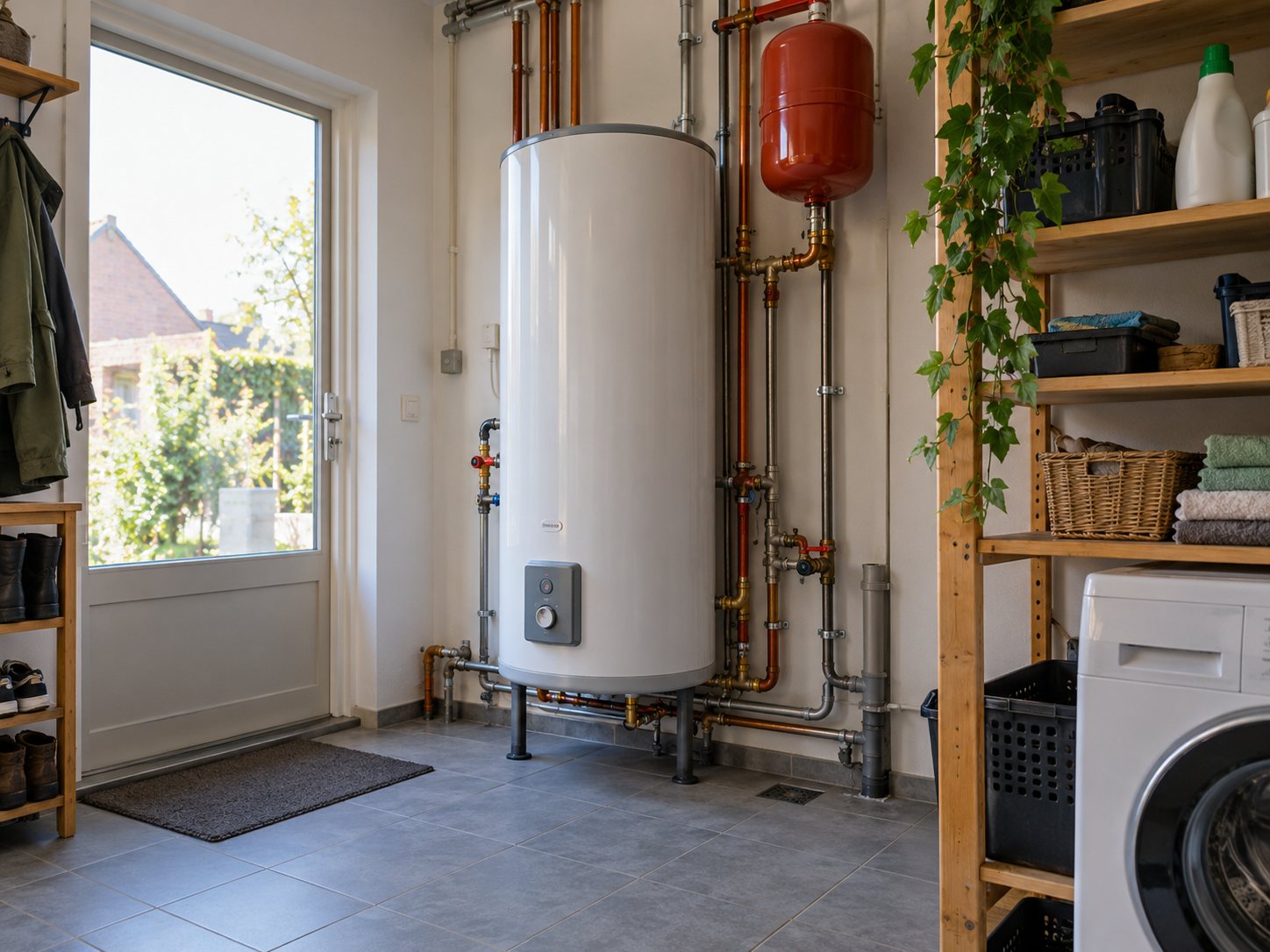
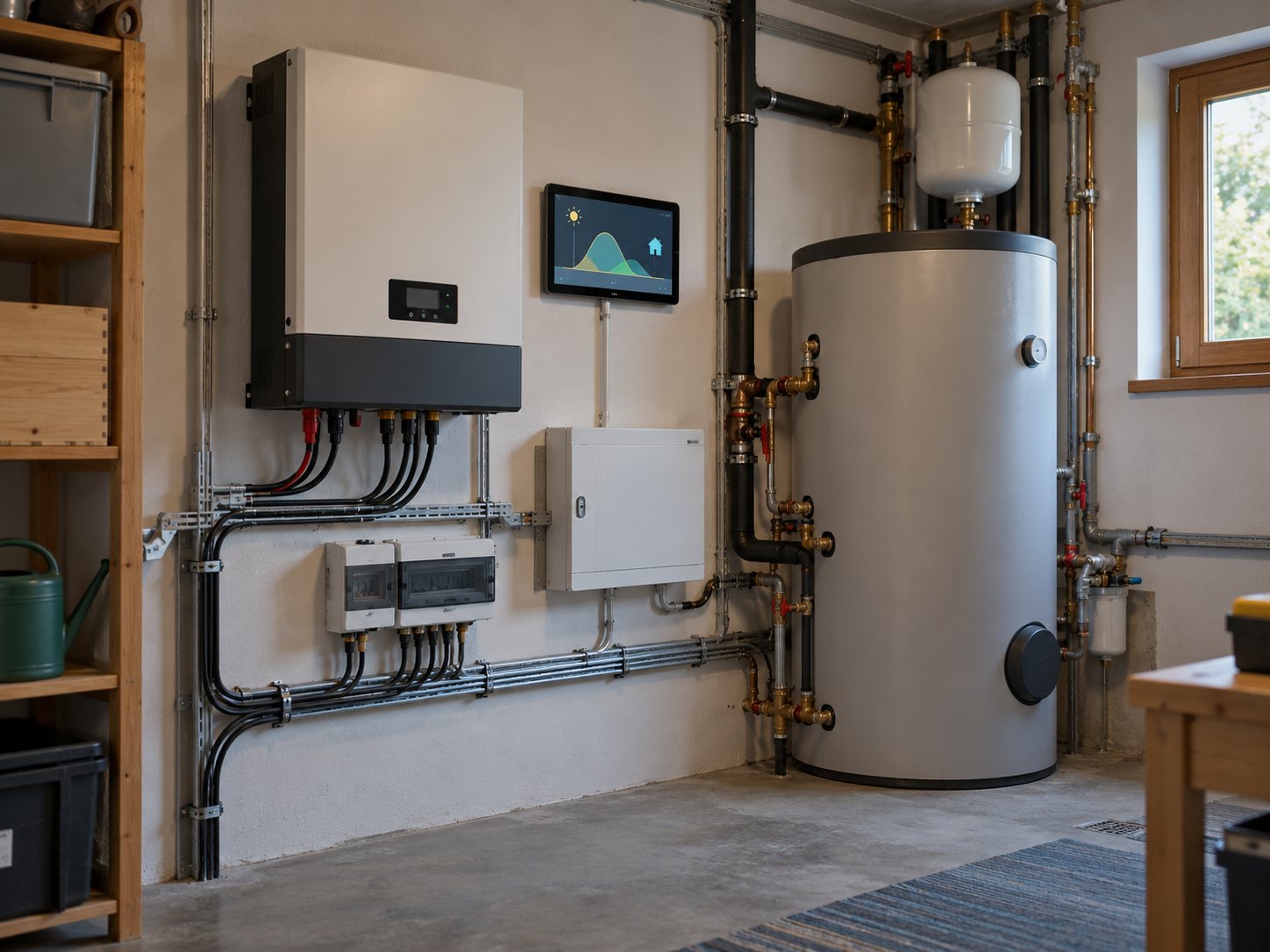
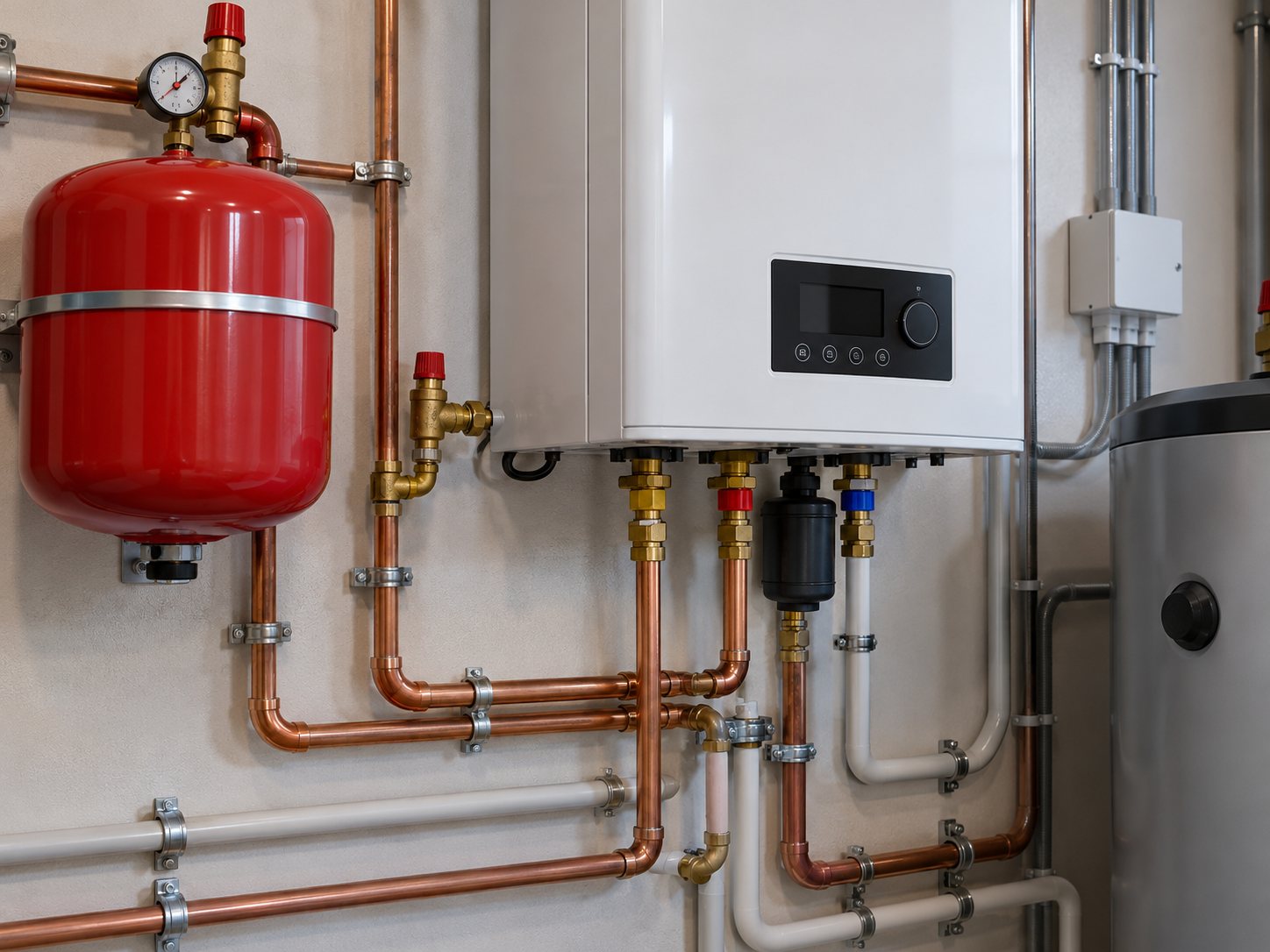
Work on the consumer unit and fixed electrical connection belongs with a qualified installer. The pictures in this publication are atmospheric and conceptual images, not wiring instructions.
12. Costs and wear that are often forgotten
A hot-water tank loses some heat day and night. Standby losses depend on insulation, capacity, ambient temperature and the set water temperature. With an additional tank, these losses add up. With an existing tank, a different heating time can also change them slightly.
Suppose an extra tank loses an average of 0.8 kWh of heat per day. Over a year, that is about 292 kWh. If this is replenished by resistance heating using grid electricity at €0.30/kWh, it theoretically represents about €88 a year in electricity. Not all losses cause that bill in every situation, but the example shows why financial performance is about more than purchase price.
Other items include installation, necessary electrical changes, periodic inspection, limescale, maintenance and possible replacement of parts. A home battery has different costs: inverter losses, degradation, electronics and possibly battery replacement.
13. What happens in winter?
The seasonal difference is large. In summer there is often plenty of solar electricity available, while demand for domestic hot water does not increase in the same proportion. In winter PV production is lower but hot-water use continues. Even a smart-controlled boiler will then need grid electricity more often.
A bigger tank does not solve this. A boiler tank can shift energy from afternoon to evening, but cannot store summer energy until January. It is a daily buffer, not seasonal storage.

14. When is a boiler better than a home battery?
| Question | Electric boiler | Home battery |
|---|---|---|
| What is stored? | Heat in water | Electrical energy |
| Can it power a television or refrigerator? | No | Yes, depending on the system |
| Possible with simple control? | Yes, especially with an existing boiler | Sometimes, but more often complex |
| Additional investment if the boiler is already present | Often limited | Usually substantial |
| If poorly utilised | Unnecessary heat losses | Unused capacity and fixed costs |
| Usable during a power outage? | Only the hot-water reserve already present | Only with a suitable backup-power function |
| Efficiency compared with a heat-pump water heater | Less efficient per kWh of heat | Not directly comparable |
This is not a contest with one winner. If you only need to shift hot-water heating, you may gain little from a battery’s extra capabilities. If you also want to power the car, kitchen and appliances in the evening, a hot-water tank will not do that.
15. Three realistic household situations
Household A: existing 120-litre electric boiler
The boiler is already there, has a suitable electrical heating circuit and, according to its manufacturer, can safely heat at a different time. The home regularly exports electricity during the day. A modest investment in control can move existing hot-water production to the afternoon. This is the most favourable starting point for the boiler idea.
Household B: gas boiler and many solar panels
The residents want to buy an extra boiler. The possible gas savings must be weighed against foregone export revenue, the investment and standby losses. An extra tank is often harder to justify financially here than in household A.
Household C: all-electric home with a heat-pump water heater
The installation already makes hot water efficiently. Usually the most sensible first step is to examine whether the existing heat-pump water heater can run during the day or charge its storage tank, within the manufacturer’s settings. Adding a separate resistance boiler just to increase self-consumption of PV electricity is often energetically unfavourable.

16. Practical checklist before you begin
- Check whether you already make hot water electrically and how it is controlled now.
- Find the rating plate, element power, capacity and manufacturer’s instructions.
- Examine hourly or quarter-hourly export and grid-import data.
- Determine how much electricity used for hot water can actually be shifted in time.
- Calculate using the net payment for electricity you would otherwise export.
- Determine the cost of controls, installation and additional heat losses.
- Check existing temperature routines and hygienic safety.
- Have a qualified installer assess the electrical and water connections.
- Then test the effect for several weeks with actual kWh measurements.
What you should especially avoid
Do not buy an extra electric boiler solely because you have solar panels. First calculate whether its heat will actually be used and which existing heating it will replace. More self-consumption is not a gain if it mostly creates new, unnecessary consumption.
17. Conclusion
An electric boiler is not a cheap copy of a home battery. It is a different technology, with a narrower purpose and sometimes a surprisingly practical application. If you already have an electric storage boiler, you can often investigate whether heating it during sunny hours is better, with little additional hardware.
But buying a completely new electric tank as an “energy measure” is far from always sensible. Especially where hot water is currently made with an efficient heat pump, extra resistance heating can increase total electricity use. A higher self-consumption ratio may look impressive on a dashboard, but it does not tell you whether the energy bill actually falls.
The best order is therefore simple: measure, calculate, optimise the existing system and only then buy new equipment.
Sources and context
[1] Dutch central government — Net metering ends in 2027. Statutory end of net metering and the principle of export compensation.
[2] ACM ConsuWijzer — Net metering and exporting electricity. Contracts, net export revenue and charges.
[3] Milieu Centraal — Use more of your own solar electricity. Explanation of solar-electricity boilers, existing electric boilers and heat pumps.
[4] RIVM — Legionella guidance. Drinking-water safety, NEN 1006 and the Waterwerkbladen.
[5] Brabant Water — Safe drinking water at home. Practical guidance on Legionella and hot-water appliances.
Publication information: October 2026. Photographs are illustrative and are not installation diagrams. Tariffs and investments in the examples are fictional assumptions; check your own contract and installation details. This article provides general technical information and does not replace advice or a design from a qualified installer.